Injection Mold Tooling Costs 2026: How US Buyers Save 50–65% on Custom Molds
March 9, 2026 · 16 min read
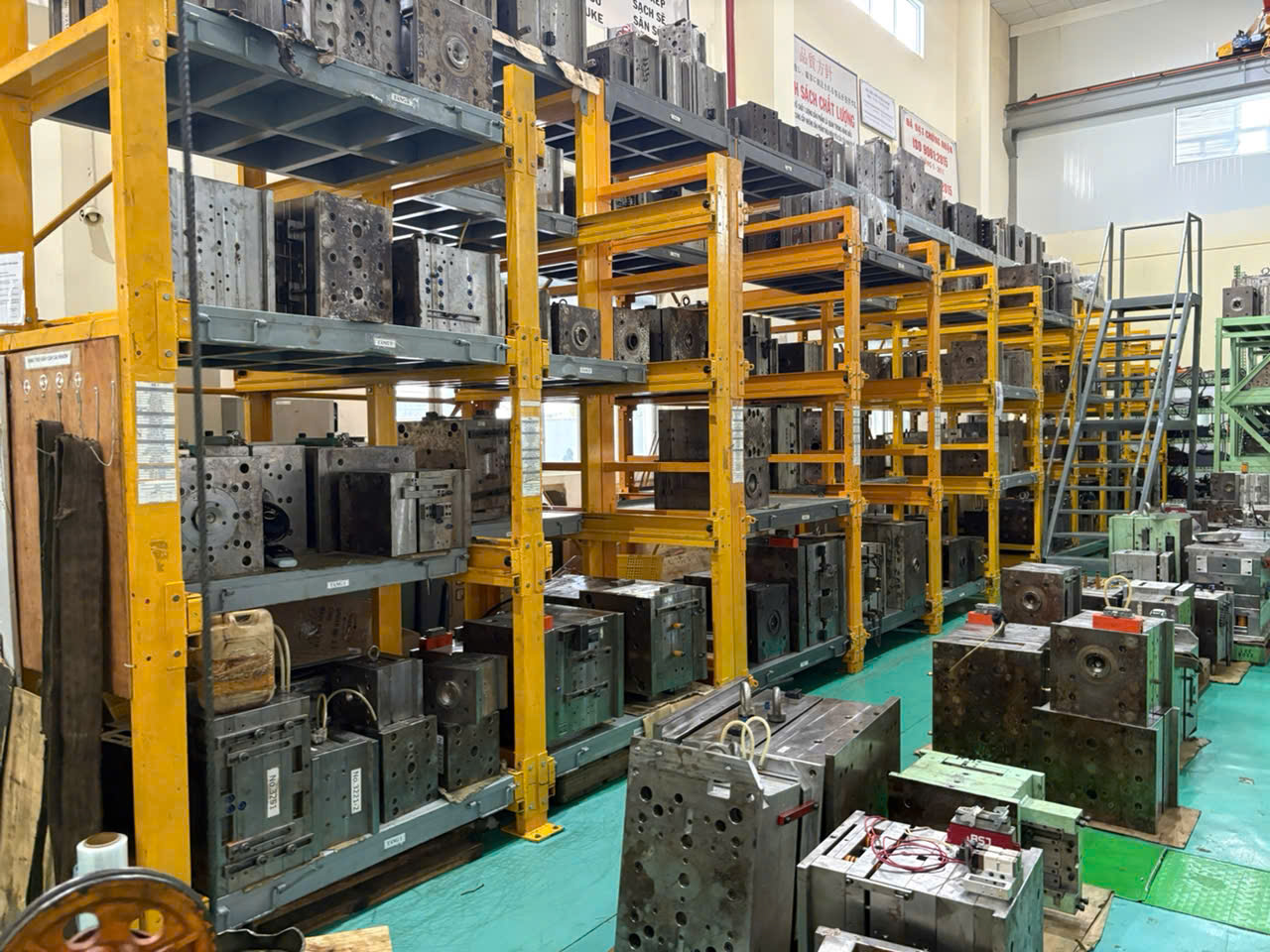
Mold tooling is the single largest upfront cost in injection molding — and the single biggest opportunity for savings. A mold that costs $45,000 from a US tool shop can cost $15,000–20,000 from a qualified Vietnamese mold maker, with comparable quality and mold life. Add China's 25% Section 301 tariff on imported molds (HTS 8480.71), and Vietnam's tariff-free advantage becomes even more decisive.
This guide gives US procurement teams the real numbers: what mold tooling actually costs by complexity, which steel grades matter, how to evaluate offshore mold makers, and the landed cost math that makes Vietnam the smartest sourcing decision for injection mold tooling in 2026.
What Drives Injection Mold Tooling Cost?
Every mold quote is built from six cost drivers. Understanding these lets you negotiate intelligently and spec molds that balance performance with budget:
- Part complexity — Undercuts, side actions, lifters, and collapsing cores add mechanisms to the mold. A simple open-and-shut mold might have 2 plates; a complex mold with 4 side actions has 6+ moving components. Each action adds $1,500–5,000 to US tooling cost ($500–2,000 in Vietnam).
- Number of cavities — A single-cavity mold costs 1x. A 4-cavity mold costs roughly 2.5–3x (not 4x — the mold base, hot runner, and engineering are shared). More cavities = lower per-part cost but higher upfront investment.
- Mold steel grade — Aluminum (7075-T6) for prototypes (1,000–10,000 shots). P20 pre-hardened steel for production (100,000–500,000 shots). H13 hardened steel for high-volume (500,000–2,000,000+ shots). NAK80 for mirror-finish optical parts. S136 (or equivalent 420 SS) for corrosive resins like PVC or POM.
- Part size — Larger parts need larger mold bases, bigger machines to cut, and more CNC time. A mold for a 50mm part might weigh 200 kg. A mold for a 500mm automotive panel weighs 2,000–5,000 kg.
- Surface finish requirements — SPI A-1 (mirror polish) costs 3–5x more than SPI D-3 (as-machined texture). EDM texturing (VDI/MT standards) adds $2,000–8,000 per cavity depending on depth and pattern.
- Hot runner vs. cold runner — Hot runner systems ($3,000–15,000 for the manifold + nozzles) eliminate runners, reducing material waste 15–30% and cycle time 10–20%. Cost-effective at volumes above 50,000 parts.
Mold Tooling Cost Benchmarks: US vs Vietnam vs China (2026)
Real pricing from our network. All figures are for P20 steel, cold runner, SPI B-2 finish unless noted:
Simple Parts (box, cap, cover — no side actions)
- Single cavity: $15,000–30,000 (US) · $8,000–15,000 (China + 25% tariff = $10,000–18,750) · $5,000–12,000 (Vietnam, 0% tariff)
- 4-cavity: $35,000–65,000 (US) · $18,000–32,000 (China + tariff = $22,500–40,000) · $12,000–25,000 (Vietnam)
Medium Complexity (housing, enclosure — 1–2 side actions)
- Single cavity: $30,000–60,000 (US) · $15,000–30,000 (China + tariff = $18,750–37,500) · $10,000–22,000 (Vietnam)
- 4-cavity: $70,000–130,000 (US) · $35,000–65,000 (China + tariff = $43,750–81,250) · $25,000–50,000 (Vietnam)
High Complexity (multi-component housing — 3+ side actions, lifters, hot runner)
- Single cavity: $60,000–120,000 (US) · $30,000–60,000 (China + tariff = $37,500–75,000) · $20,000–45,000 (Vietnam)
- 8-cavity: $150,000–300,000 (US) · $75,000–150,000 (China + tariff = $93,750–187,500) · $50,000–110,000 (Vietnam)
Bottom line: Vietnam mold tooling runs 50–65% less than US domestic and 15–30% less than China after tariffs. For a $100,000 US mold, you're looking at $35,000–50,000 from Vietnam — saving $50,000–65,000 on a single tool.
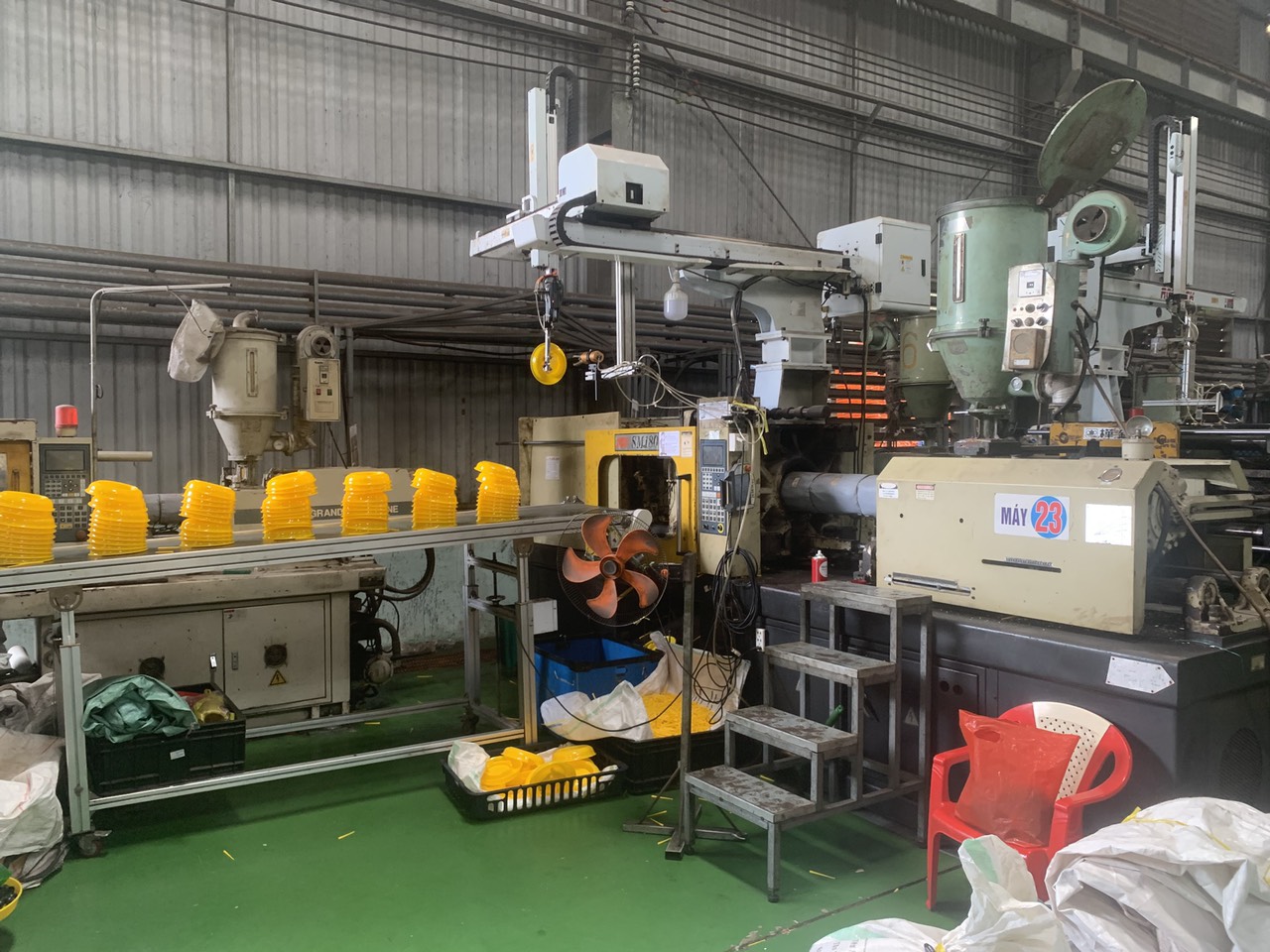
Mold Steel Selection: What Actually Matters
Don't over-spec steel — it's the most common way to blow your tooling budget. Here's when each grade makes sense:
- Aluminum 7075-T6 (prototype molds) — Mold life: 1,000–10,000 shots. Cuts 5x faster than steel, reducing tooling lead time to 2–3 weeks. Cost: 30–50% of a steel mold. Use for design validation, bridge production, or parts that may change. Don't use for glass-filled resins (they destroy aluminum in 500 shots).
- P20 pre-hardened (28–34 HRC) — The workhorse. 85% of production molds use P20 or equivalent. Mold life: 100,000–500,000 shots. Easy to machine, easy to repair, widely available. This is your default choice unless you have a specific reason to go harder.
- H13 hardened (48–52 HRC) — For high-volume programs (500,000–2,000,000+ shots) or glass-filled/mineral-filled resins that cause accelerated wear. H13 costs 20–35% more than P20 but lasts 3–5x longer. The break-even point is typically around 300,000–500,000 shots.
- S136 / 420 Stainless (48–52 HRC) — Required for PVC, POM (Delrin), and flame-retardant resins that release corrosive gases during molding. Also used for medical/food-contact parts requiring mirror polish. 30–50% premium over P20.
- NAK80 (pre-hardened, 38–42 HRC) — For optical-grade surfaces and high-gloss consumer products. Machines to SPI A-1 mirror finish without post-heat-treatment distortion. Popular for cosmetic electronics housings and automotive lens covers. 25–40% premium over P20.
The Tariff Math: Why China Molds No Longer Make Sense
Let's walk through the real numbers for a mid-complexity mold (electronics enclosure, 2 side actions, single cavity):
- US domestic mold shop: $45,000. Lead time: 10–14 weeks.
- China mold shop: $18,000 base price + $4,500 (25% Section 301 tariff on HTS 8480.71) + $1,200 (freight/crating) = $23,700 landed. Lead time: 6–8 weeks + 3–4 weeks ocean freight.
- Vietnam mold shop: $15,000 base price + $0 tariff (MFN rate 0–3.4%) + $1,400 (freight/crating) = $16,400 landed. Lead time: 6–8 weeks + 3 weeks ocean freight.
Vietnam saves $7,300 vs. China landed (31% cheaper) and $28,600 vs. US domestic (64% cheaper). Multiply that across a program with 5–10 molds and you're looking at $40,000–70,000 in savings — enough to fund your entire product validation phase.
How to Evaluate an Offshore Mold Maker
Cheap tooling that doesn't hold tolerance or breaks after 50,000 shots costs more than expensive tooling that runs for 500,000 shots. Here's how to separate capable mold shops from disasters:
1. In-House CNC and EDM Capability
A real mold maker has high-speed CNC machining centers (Makino, OKK, or equivalent), wire EDM (Sodick, Mitsubishi, Fanuc), and sinker EDM. If they outsource core/cavity machining, they're an assembler, not a mold maker. Ask for machine lists with brand, model, and count.
2. DFM Report Before Quoting
Top-tier mold shops provide a Design for Manufacturability report before you commit — identifying wall thickness issues, draft angle problems, gate location recommendations, and cooling challenges. A shop that just sends a number without DFM feedback is a red flag.
3. Mold Flow Analysis
For any mold over $15,000, the shop should run Moldflow or equivalent simulation showing fill pattern, weld line locations, air trap risks, and warpage prediction. This costs the shop $500–1,000 in engineering time but prevents $5,000–15,000 in rework.
4. First Article Inspection Protocol
The mold maker should run T1 (first trial) samples, measure them against your drawing using CMM, and provide a dimensional report with photos before shipping the mold. Expect T1 to T3 trials — molds rarely hit spec on the first shot.
5. Steel Certification
Request mill certificates for all core/cavity steel. Vietnamese mold makers typically source steel from Daido (Japan), Assab (Sweden/Uddeholme), or Bohler (Austria). If a shop can't provide mill certs, the steel origin is unknown — and that means unknown mold life.
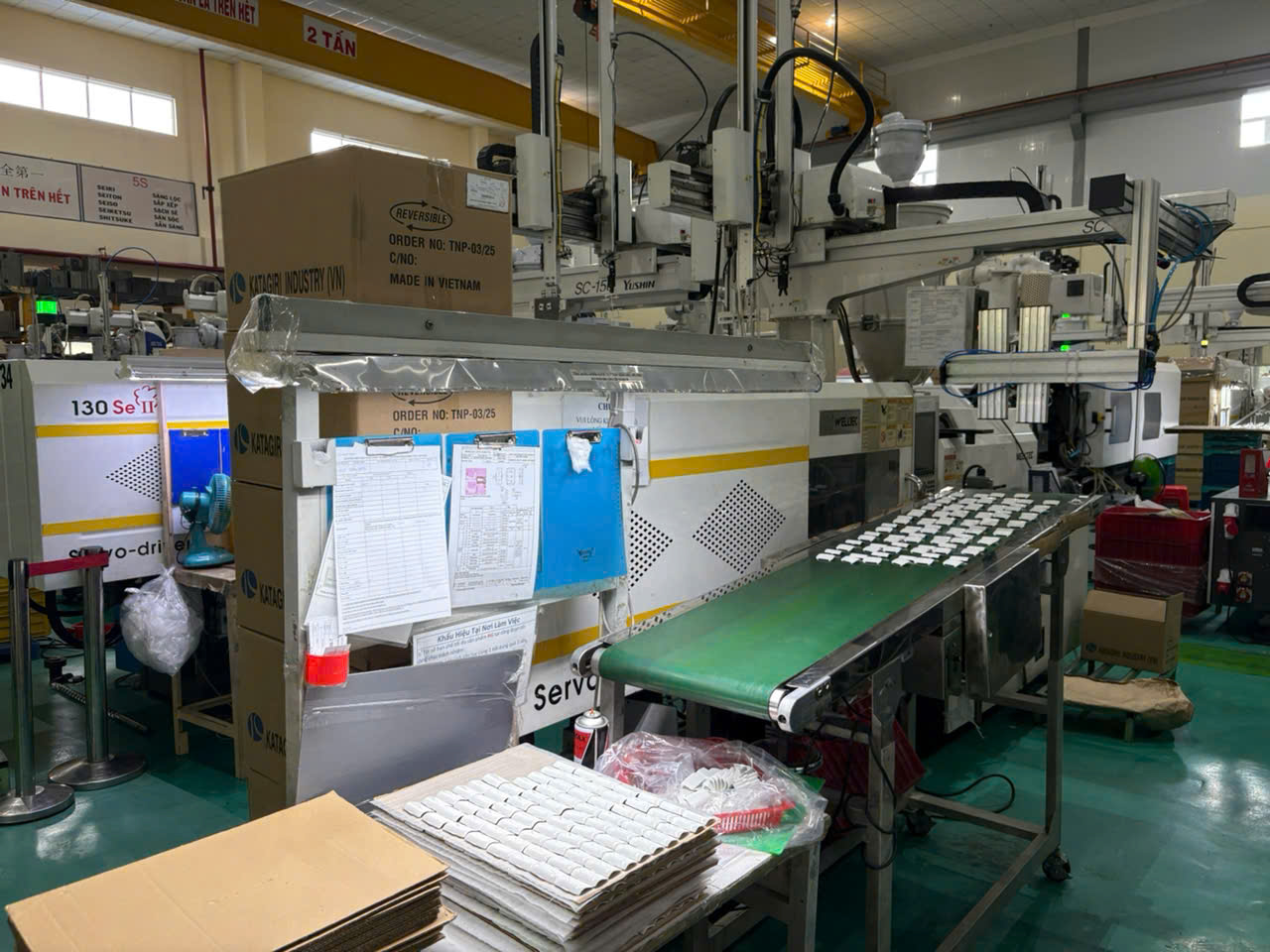
Mold Types Explained: Which One You Need
Two-Plate Mold (Standard)
The simplest and most common mold type. Two halves separate at one parting line. Parts eject from the B-side (moving half) via ejector pins. Works for most parts without undercuts.
- Cost: Base configuration (no multiplier)
- Use when: Part can be molded with straight pull, no undercuts
Three-Plate Mold
Adds a stripper plate that separates the runner system from the parts automatically. Allows center gating on parts where edge gating isn't possible. Costs 20–35% more than two-plate.
- Cost: 1.2–1.35x two-plate
- Use when: Center gate needed, cold runner system, multi-cavity with separate runner drops
Hot Runner Mold
The runner system stays molten — no runner waste, no regrind, faster cycles. The hot runner manifold and nozzles add $3,000–15,000 to mold cost but save 15–30% on material and reduce cycle time by 10–20%.
- ROI break-even: Typically 30,000–80,000 parts depending on resin cost
- Use when: High-volume production, expensive resins, tight cycle time targets
Family Mold
Multiple different parts in one mold (e.g., a housing top and bottom). Saves tooling cost vs. two separate molds, but balancing fill across dissimilar cavities is challenging. Unbalanced fill leads to short shots or flash.
- Cost: 60–75% of two separate molds
- Risk: Parts of very different sizes or wall thicknesses often can't be balanced — test with Moldflow first
Mold Lead Time: What to Expect
- Aluminum prototype mold: 2–3 weeks (Vietnam) · 3–5 weeks (US)
- Simple production mold (P20, no actions): 4–6 weeks (Vietnam) · 8–12 weeks (US)
- Medium complexity (P20/H13, 1–2 actions): 6–8 weeks (Vietnam) · 10–14 weeks (US)
- High complexity (H13, 3+ actions, hot runner): 8–12 weeks (Vietnam) · 12–18 weeks (US)
- Ocean freight to US West Coast: 18–22 days
Total program time from PO to mold in your US facility: 8–16 weeks from Vietnam vs. 8–18 weeks US domestic. Vietnam tooling is not slower — and it's half the price.
5 Costly Mistakes to Avoid
- Ordering an 8-cavity mold for an unproven design. Start with a single-cavity mold. Validate the design, test the market. Then scale to multi-cavity once you're running 50,000+ parts/year. The $10,000 single-cavity mold from Vietnam is your best insurance against design changes.
- Specifying H13 when P20 is enough. If your lifetime volume is under 300,000 parts, P20 at 28–34 HRC is plenty. H13 adds 25–35% to mold cost for durability you may never need.
- Ignoring cooling circuit design. Cooling accounts for 60–80% of cycle time. A mold with poor cooling channels runs 40–60 second cycles instead of 20–30 seconds — doubling your per-part cost. Demand conformal cooling or at minimum optimized baffle/bubbler placement.
- No gate vestige specification. If the gate mark matters (visible surfaces), specify it on your drawing. Sub-gates and tunnel gates leave minimal vestige but cost more. Tab gates are cheapest but leave a visible mark that requires trimming.
- Not clarifying mold ownership. Specify in your PO that you own the mold. Offshore, always confirm the mold can be shipped to you or transferred to another supplier. Some shops hold molds hostage to keep production orders.
RFQ Checklist for Mold Tooling
Include these in every mold RFQ to get accurate, comparable quotes:
- 3D CAD file (STEP or Parasolid preferred)
- 2D drawing with GD&T and critical dimensions called out
- Material spec (resin grade, not just "ABS" — specify Chimei PA-757 or equivalent)
- Annual volume estimate (drives cavity count decision)
- Lifetime volume estimate (drives steel grade decision)
- Surface finish requirement (SPI class or VDI texture)
- Color requirements (affects gate location and weld line visibility)
- Gate type preference (if any — or let the mold maker recommend)
- Hot runner preference (specify brand: Yudo, Mold-Masters, Synventive)
- Mold shipping destination and ownership terms
Get a Mold Tooling Quote in 48 Hours
Send us your 3D CAD + volume estimate. We'll return a DFM report, Moldflow-validated gate/cooling recommendation, and tooling quote from our vetted Vietnam mold shops — with steel certification and mold life guarantee. We manage the entire process: design review, T1 samples, dimensional validation, and freight to your US facility.