Investment Casting vs. Die Casting: Which Process Fits Your Part?
February 24, 2026 · 13 min read
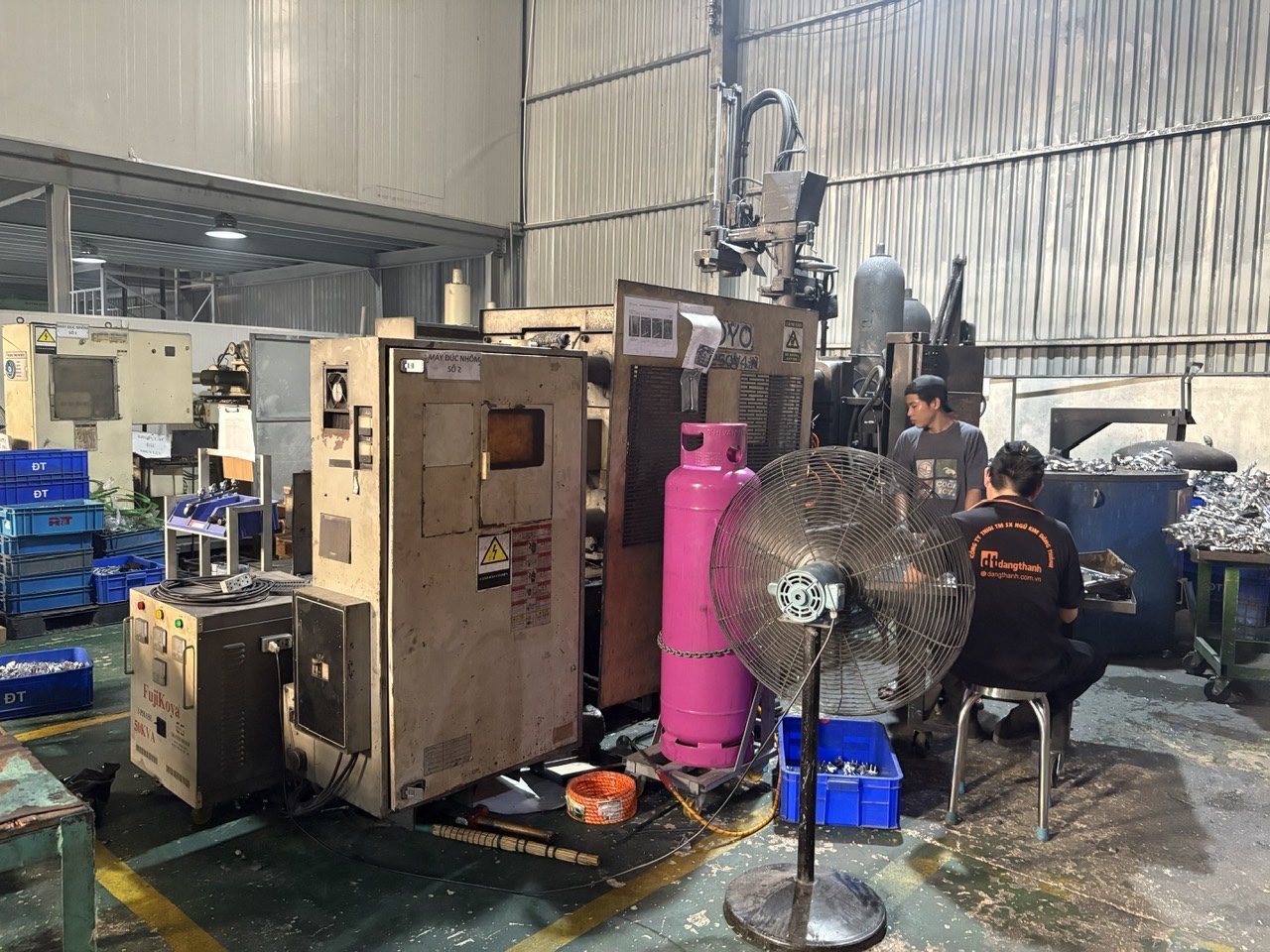
Investment casting and die casting both produce near-net-shape metal parts, but they're fundamentally different processes optimized for different use cases. Choosing the wrong one costs you — either in excessive tooling for low volumes, or in unnecessary per-part expense at high volumes.
This guide gives you the engineering and commercial data to make the right call, including real 2026 pricing from both US and Vietnam suppliers.
How Each Process Works
Investment Casting (Lost Wax)
A wax pattern is injection-molded, coated in ceramic slurry (5–8 layers over 3–5 days), the wax is melted out ("invested"), and molten metal is poured into the ceramic shell. After cooling, the shell is broken away and the casting is finished.
- Cycle: 1–2 weeks per batch (ceramic shell building is the bottleneck)
- Batch size: Typically 50–500 parts per pour (tree assembly of multiple wax patterns)
- Materials: Almost any castable alloy — stainless steel (304, 316, 17-4PH), carbon steel, tool steel, Inconel, titanium, cobalt-chrome, brass, aluminum, bronze
- Wall thickness: As thin as 1.0 mm (vs. 1.5–2.0 mm for die casting)
Die Casting (High Pressure)
Molten metal is injected at 10,000–25,000 psi into a hardened steel die. The die opens, the part is ejected, and the cycle repeats every 30–90 seconds. Extremely fast, extremely repeatable.
- Cycle: 30–90 seconds per shot
- Batch size: Continuous — dies run 50,000–500,000+ cycles before rebuild
- Materials: Limited to low-melting-point alloys — aluminum (A380, A383, ADC12), zinc (Zamak 3, 5), magnesium (AZ91D). No ferrous metals, no stainless, no superalloys.
- Wall thickness: 1.5–2.0 mm minimum (thinner risks cold shuts and misruns)
Head-to-Head Comparison
| Factor | Investment Casting | Die Casting |
|---|---|---|
| Tooling cost | $2,000–15,000 | $15,000–100,000+ |
| Per-part cost @ 500 pcs | $5–50 | $30–200 (tooling amortization kills it) |
| Per-part cost @ 10,000 pcs | $4–40 | $0.80–8 |
| Per-part cost @ 100,000 pcs | $3–30 | $0.30–3 |
| Tolerances (linear) | ±0.10–0.25 mm | ±0.05–0.15 mm |
| Surface finish (as-cast) | Ra 1.6–3.2 µm (excellent) | Ra 1.6–6.3 µm (good) |
| Maximum part weight | 50 kg (typical), 200 kg+ possible | Up to 20 kg (aluminum), 5 kg (zinc) |
| Complexity | Undercuts, internal passages, thin walls — almost unlimited | Good complexity but requires draft angles, slides add cost |
| Alloy range | Virtually unlimited — ferrous, non-ferrous, superalloys | Aluminum, zinc, magnesium only |
| Porosity | Very low — pressure-tight castings possible | Inherent porosity from trapped air — problematic for pressure applications |
| Lead time (first articles) | 4–8 weeks | 8–14 weeks (die machining is slow) |
When to Choose Investment Casting
- You need stainless steel, tool steel, or superalloys — Die casting physically cannot process ferrous metals. If your part must be SS316, 17-4PH, Inconel 625, or any steel, investment casting is your only near-net-shape option (besides forging or MIM).
- Volume is under 5,000–10,000/year — Tooling cost of $3,000–10,000 vs. $25,000–80,000 makes investment casting the clear winner for low-mid volumes. The crossover point depends on part complexity, but 5,000–10,000 units/year is typical.
- Complex internal passages — Soluble wax cores create internal geometries that would require multiple die casting slides or be impossible. Valve bodies, pump impellers, turbine blades — investment casting territory.
- Thin walls under 1.5 mm — Investment casting reliably fills walls down to 1.0 mm. Die casting below 1.5 mm risks cold shuts and short fills, especially in aluminum.
- Pressure-tight requirements — Hydraulic manifolds, valve bodies, and fluid handling components need porosity-free castings. Investment casting's gravity/vacuum pour produces denser castings than high-pressure die casting.
When to Choose Die Casting
- Volume exceeds 10,000/year in aluminum or zinc — Die casting's 30–90 second cycle time makes it unbeatable at volume. A part costing $15/pc in investment casting drops to $1–3/pc in die casting at 50K+ volume.
- Dimensional consistency is critical — Die casting tolerances (±0.05–0.10mm) are tighter than investment casting out of the mold. For parts requiring ±0.05mm without secondary machining, die casting wins.
- Cosmetic surface requirements — Die cast parts can be powder coated, anodized, or chrome plated directly. Investment casting surfaces are good but may need more finishing for cosmetic applications.
- You need integrated features — Bosses, ribs, snap fits, threads (via inserts), and logos can be molded directly into die cast parts, reducing assembly operations.
- Zinc parts under 500g — Zinc die casting (Zamak 3/5) in hot-chamber machines runs at 15–30 second cycles with excellent detail reproduction. Perfect for hardware, connectors, handles, and decorative components.
Real 2026 Cost Examples
Example 1: Stainless Steel Valve Body (SS316, 200g)
- Investment casting (Vietnam): Tooling $4,000–6,000 · $12–18/pc at 1,000 qty · $8–14/pc at 5,000 qty
- Investment casting (US): Tooling $8,000–15,000 · $25–45/pc at 1,000 qty · $18–30/pc at 5,000 qty
- Die casting: Not possible — SS316 cannot be die cast
- CNC from billet (comparison): $35–80/pc at 1,000 qty — investment casting saves 50–70%
Example 2: Aluminum Bracket (A380, 150g, cosmetic finish)
- Die casting (Vietnam): Tooling $12,000–20,000 · $1.20–2.50/pc at 10,000 qty · $0.60–1.30/pc at 50,000 qty
- Die casting (China): Tooling $8,000–15,000 · $0.80–1.80/pc at 10,000 qty (+ 25% Section 301 tariff)
- Investment casting (Vietnam): Tooling $3,000–5,000 · $6–12/pc at 1,000 qty · $4–8/pc at 10,000 qty
- Crossover point: Die casting becomes cheaper at ~3,000–5,000 units/year for this part
Example 3: Zinc Connector Housing (Zamak 3, 45g, high detail)
- Die casting (Vietnam): Tooling $8,000–15,000 · $0.25–0.60/pc at 50,000 qty · $0.12–0.30/pc at 200,000 qty
- Investment casting: Not recommended — zinc is rarely investment cast; die casting is superior in every way for zinc at any volume above 1,000.
Design Rules: DFM Tips for Each Process
Investment Casting DFM
- Uniform wall thickness — Target 3–6 mm for steel. Transitions should be gradual (3:1 taper ratio) to avoid shrinkage porosity at thick-to-thin junctions.
- Fillets everywhere — Minimum 1 mm inner radii, 2 mm preferred. Sharp corners cause ceramic shell cracking and stress concentration in the casting.
- Draft angles optional — Unlike die casting, investment casting wax patterns are extracted from soft rubber or aluminum molds. Zero draft is possible on external surfaces, though 0.5–1° helps wax pattern ejection.
- Machining allowance — Add 0.5–1.0 mm stock on critical surfaces that will be CNC finished. As-cast tolerance of ±0.15 mm may not be sufficient for mating interfaces.
- Gate location — Discuss with foundry. Gate removal leaves a witness mark (~3–5 mm diameter). Don't place gates on sealing or cosmetic surfaces.
Die Casting DFM
- Draft angles required — 1–3° minimum on all surfaces parallel to die pull direction. Deeper cavities need more draft. Zero-draft is achievable with slides but adds $2,000–8,000 per slide to tooling.
- Wall thickness — 1.5–4 mm for aluminum, 0.8–3 mm for zinc. Keep uniform — thick sections cause sink marks and porosity. Core out thick areas with ribs instead.
- Ribs — 60–80% of wall thickness, 3:1 max height-to-thickness ratio. Ribs stiffen parts without adding mass or cycle time.
- Undercuts — Possible with slides or collapsible cores but add $3,000–10,000 each to tooling. Redesign to eliminate undercuts where possible.
- Parting line — Plan early. Complex parting lines increase die cost and flash. Simple, planar parting lines = cheaper tooling and cleaner parts.
Vietnam Sourcing: Investment Casting & Die Casting
Vietnam has strong capabilities in both processes, with important differences:
- Die casting — Well-established. Vietnam has 200+ die casting facilities, many serving Japanese and Korean automotive OEMs. Aluminum and zinc die casting are mature processes with competitive pricing 5–15% above China before tariffs, and below China after 25% Section 301 duties.
- Investment casting — Growing but smaller. 30–50 investment casting foundries, primarily producing stainless steel and carbon steel components for valve, pump, and marine hardware industries. Quality ranges widely — audit before committing.
- Tariff advantage — Cast aluminum parts from China face 25% Section 301 tariffs (HTS 7616). Vietnam: 0%. On a $500K annual die casting spend, that's $125K in tariff savings.
- Secondary machining — Most Vietnam die casting and investment casting factories have in-house CNC for post-cast machining. One-stop shop reduces lead time and coordination overhead vs. separate casting + machining suppliers.
Other Casting Processes Worth Considering
- Sand casting — Cheapest tooling ($500–5,000). Roughest tolerances (±0.5–1.0 mm). Best for large parts (up to hundreds of kg), iron/steel, and very low volumes (1–500 pcs). Available widely in Vietnam.
- Gravity die casting (permanent mold) — Steel mold, gravity pour. Between sand and high-pressure die casting in cost and quality. Good for aluminum parts in 500–20,000 qty range. Tooling: $5,000–25,000.
- MIM (Metal Injection Molding) — For small, complex parts under 50g in steel or stainless. Tooling: $10,000–30,000. Per-part: $1–5 at 50K+ volume. Competing with investment casting at high volumes for small parts. Limited Vietnam availability — mostly China, Japan, Korea.
Decision Flowchart
- Material is steel/stainless/superalloy? → Investment casting (or sand casting for large/low-volume)
- Material is aluminum/zinc AND volume >5,000/yr? → Die casting
- Material is aluminum AND volume <5,000/yr? → Investment casting or gravity die casting
- Part weight >20 kg? → Sand casting or investment casting (not die casting)
- Pressure-tight required? → Investment casting or gravity die casting (not HPDC)
- Complex internals? → Investment casting with soluble cores
- Cosmetic + high volume? → Die casting with proper surface finish spec
Get Casting Quotes from Vietnam
Dewin sources investment castings, die castings, and sand castings from audited Vietnam foundries. Send us your 3D model and volume requirements — we'll recommend the optimal process and provide competitive quotes within 48 hours.