Custom Hydraulic Manifold Blocks: CNC Machining Sourcing Guide 2026
February 25, 2026 · 14 min read
Hydraulic manifold blocks are the central nervous system of any hydraulic circuit. They route pressurized fluid between pumps, valves, actuators, and reservoirs through a network of precisely drilled internal passages — replacing miles of external tubing with a single compact block. Getting them right requires a CNC machining supplier who understands deep-hole drilling, pressure-rated intersections, and the unforgiving tolerances of hydraulic cartridge valve cavities.
This guide covers everything a procurement engineer needs to spec, source, and evaluate custom hydraulic manifold blocks — with real 2026 pricing data from our supplier network.
Why Manifold Blocks Are Harder to Machine Than They Look
A hydraulic manifold might appear simple — it's a rectangular block with holes. But those holes intersect at precise angles inside the block, operate at 3,000–6,000 PSI (some systems hit 10,000 PSI), and must seal against cartridge valves with zero leakage. Here's what makes manifold machining uniquely challenging:
- Deep-hole drilling — Passages commonly reach 10:1 to 20:1 length-to-diameter ratios. A Ø8 mm passage running 160 mm deep requires gun drilling or BTA drilling to maintain straightness within 0.5 mm over the full depth. Standard twist drills wander unacceptably beyond 5:1 L/D.
- Intersecting bores — Where two passages cross, the intersection geometry affects flow dynamics and fatigue life. Sharp corners create stress concentrations — at 5,000 PSI, a poorly deburred intersection can initiate a crack within 500,000 pressure cycles.
- Cartridge valve cavities — Sun Hydraulics, Eaton, Bosch Rexroth, and Parker all publish cavity specs (ISO 7789 / NFPA T3.5.31). Tolerances on cavity diameter are typically ±0.013 mm (±0.0005"), with surface finish Ra 0.4–0.8 µm. A cavity that's 0.02 mm oversize will leak past the cartridge valve O-ring under pressure.
- Internal deburring — Every cross-drilled intersection creates burrs inside the block. These burrs break loose under flow, contaminate hydraulic fluid, and destroy pump seals and valve spools downstream. Thermal deburring (TEM), abrasive flow machining (AFM), or manual deburring with flexible hones are required.
- Pressure testing — Every manifold must be pressure tested at 1.5× working pressure (per ISO 4413 / NFPA T2.24.1). For a 5,000 PSI system, that's 7,500 PSI proof test with zero leakage for a minimum 3-minute hold.
Material Selection for Hydraulic Manifolds
Material choice depends on working pressure, fluid compatibility, weight constraints, and corrosion environment. Here's the decision matrix:
6061-T6 Aluminum — Up to 3,000 PSI
Best for mobile hydraulics where weight matters — agricultural equipment, forklifts, aerial work platforms. 40 ksi yield strength limits working pressure to ~3,000 PSI with adequate safety factor (4:1 on yield for aluminum per ASME). Machines 3× faster than steel — significantly cheaper per block. Weight: ~2.7 g/cm³ (⅓ of steel). Material cost: $3–5/kg.
Limitations: Not suitable for phosphate ester fluids (Skydrol) — causes corrosion. Fatigue life lower than steel; avoid for systems with rapid pressure cycling (>1 million cycles). Hard anodize (Type III) recommended for wear resistance on valve cavities.
A36 / 1018 Carbon Steel — Up to 5,000 PSI
Industry workhorse for industrial hydraulic systems. 36 ksi yield (A36) or 54 ksi yield (1018 cold-rolled). Adequate for most standard industrial pressures. Cheapest material option at $1.50–3/kg. Requires painting, zinc plating, or black oxide for corrosion protection — bare steel rusts immediately in humid environments.
4140 Alloy Steel — Up to 6,000+ PSI
For high-pressure systems: hydraulic presses, injection molding machine clamps, offshore equipment. 60 ksi yield (annealed), 95+ ksi (heat-treated). Can be hardened to HRC 28–32 for wear resistance. Material cost: $3–5/kg. Machines slower than 1018 — expect 30–40% longer cycle times. Must be stress-relieved after machining if heat-treated.
316 Stainless Steel — Corrosive Environments
Food processing, marine, pharmaceutical, washdown environments. 30 ksi yield (annealed), adequate to ~3,500 PSI. Material cost: $6–10/kg. Machines significantly slower than carbon steel — 40–50% longer cycle times. Work-hardens aggressively; requires sharp tooling and rigid setups.
Passivation required after machining (per ASTM A967) to restore corrosion resistance on machined surfaces.
Ductile Iron (65-45-12) — High Volume
For production volumes above 200+ blocks/year of the same design, consider casting a near-net-shape blank and finish-machining. Ductile iron offers 45 ksi yield, excellent vibration damping, and $2–4/kg material cost. Tooling for sand casting: $2,000–8,000. Payback at ~300 blocks vs. machining from billet.
Critical Tolerances for Hydraulic Manifolds
Not every dimension on a manifold needs to be tight. Here's where tolerances actually matter — and where you're wasting money if you over-spec:
Tight Tolerance (Must Spec Carefully)
- Cartridge valve cavity diameter: ±0.013 mm (±0.0005"). Per valve manufacturer spec. Undersized = valve won't install. Oversized = O-ring bypass leak.
- Cavity depth: ±0.05 mm (±0.002"). Controls valve spool position and flow characteristics.
- SAE O-ring boss ports (SAE J1926): Thread depth and spot face diameter per standard. Spot face perpendicularity ≤0.05 mm TIR to thread axis.
- Mounting surface flatness: ≤0.05 mm over full surface for subplate-mounted valves (ISO 4401 mounting patterns). Critical for D03/D05/D07 valve interfaces.
- Passage surface finish: Ra 1.6 µm max for passages, Ra 0.4–0.8 µm for valve cavities and seal grooves.
Standard Tolerance (Don't Over-Spec)
- External block dimensions: ±0.1 mm is fine. The block envelope doesn't need to be precision — only the internal features and mounting surfaces do.
- Passage position (non-intersecting): ±0.25 mm is usually adequate. Passages that terminate at plugged ports just need to be close enough to intersect their connecting passages.
- Plug hole threads: Standard thread tolerance per SAE J1926. No tighter spec needed.
Cost impact: A manifold where every dimension is called out at ±0.025 mm will cost 40–60% more than one with properly tiered tolerances. Spend 30 minutes reviewing your drawing before sending it out for quote — it can save thousands.
2026 Pricing Benchmarks: Custom Hydraulic Manifolds
Real quoted prices from our supplier network. All prices assume 6061-T6 aluminum unless noted, including deburring and pressure testing.
Small Manifold (100×80×60 mm, 8–12 cavities/ports)
Applications: compact mobile hydraulics, lab test equipment, small automation systems.
- Qty 5: $180–350/block (US) · $90–170/block (Vietnam)
- Qty 25: $120–220/block (US) · $55–110/block (Vietnam)
- Qty 100: $80–150/block (US) · $35–70/block (Vietnam)
- Qty 500: $55–100/block (US) · $25–50/block (Vietnam)
Medium Manifold (200×150×100 mm, 15–25 cavities/ports)
Applications: industrial hydraulic power units, injection molding machines, press brakes.
- Qty 5: $450–900/block (US) · $220–430/block (Vietnam)
- Qty 25: $300–550/block (US) · $140–270/block (Vietnam)
- Qty 100: $200–380/block (US) · $95–180/block (Vietnam)
- Qty 500: $140–260/block (US) · $65–130/block (Vietnam)
Large Manifold (350×250×150 mm, 30+ cavities/ports, steel)
Applications: hydraulic press main manifolds, marine deck equipment, large injection molding machines. 4140 steel, heat-treated.
- Qty 5: $1,200–2,800/block (US) · $550–1,300/block (Vietnam)
- Qty 25: $800–1,600/block (US) · $380–780/block (Vietnam)
- Qty 100: $550–1,100/block (US) · $260–530/block (Vietnam)
Steel premium: Carbon/alloy steel manifolds cost 30–50% more than aluminum of similar size due to slower machining speeds, harder-to-drill deep holes, and more expensive deburring.
What to Include in Your Hydraulic Manifold RFQ
A complete RFQ gets you accurate quotes faster and avoids the back-and-forth that delays projects. Include these items:
- Hydraulic schematic + manifold drawing. The schematic tells the machinist what the block does — which passages must connect, where flow goes, and what pressures each section handles. The manifold drawing provides exact geometry. Both are essential.
- Cartridge valve specifications. Provide manufacturer, model number, and cavity specification for every valve. Example: "Sun CBCA-LHN, T-11A cavity per Sun spec." This ensures correct cavity dimensions without ambiguity.
- Port specifications. SAE J1926 (O-ring boss) or NPT? What size? SAE -4, -6, -8, -10, -12, -16? Label every port clearly on the drawing. Include port identification tags that match your schematic.
- Working pressure per section. If different sections of your manifold operate at different pressures (common in circuits with pressure-reducing valves), callout the pressure rating per passage. This allows the machinist to optimize wall thickness and passage diameter.
- Material and surface treatment. Specify alloy, temper, and finish: "6061-T6, Type III hard anodize per MIL-A-8625 Type III, Class 1, 0.002" min thickness." For steel: "4140, hardened and tempered to HRC 28–32, zinc plated per ASTM B633 SC1."
- Testing requirements. Minimum: proof pressure test at 1.5× working pressure, 3-minute hold, zero leakage. If you need test certificates, inspection reports, or material certs (MTR), state it upfront — it's cheaper than adding it later.
- Quantity and delivery schedule. First article + production split? Blanket order with releases? Annual usage forecast? All of these affect pricing. A supplier who knows you'll order 200/year prices differently than one quoting a one-time batch of 25.
How to Evaluate a Hydraulic Manifold Supplier
Not every CNC shop can make manifolds. Here's what separates a good manifold supplier from a general machine shop:
- Gun drilling capability. Ask if they have dedicated gun drilling machines or use gun drills on their machining centers. For passages longer than 8:1 L/D, dedicated gun drilling is significantly more accurate. Ask for sample straightness data.
- Internal deburring process. "We deburr by hand" is a red flag for manifolds with 20+ cross-drilled intersections. Ask about their deburring method — thermal (TEM), abrasive flow (AFM), electrochemical, or flexible hone. Request a cleanliness standard (NAS 1638 Class 8 or ISO 4406 18/16/13 is typical for hydraulic manifolds).
- Pressure test setup. Do they have a dedicated pressure test bench? What's their maximum test pressure? Can they test individual circuits independently? A proper test bench with automated pressure logging costs $15,000–50,000 — shops that have one are serious about manifold work.
- Valve cavity experience. Ask which valve brands they've machined cavities for. Sun, Eaton, Parker, HydraForce, Bucher, Bosch Rexroth all have different cavity specs. A shop that knows the difference between a T-8A and T-11A cavity without looking it up has genuine manifold experience.
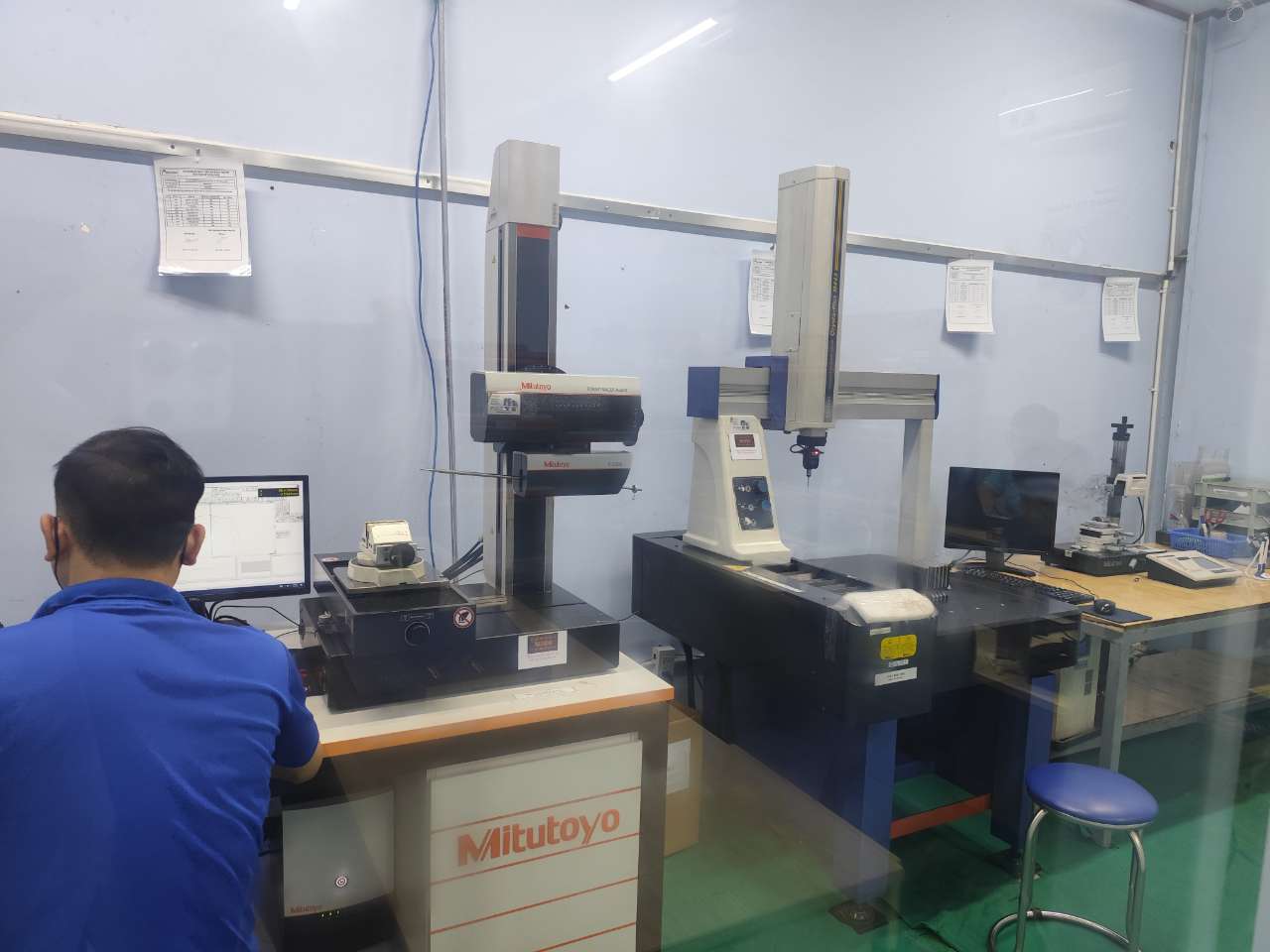
- CMM inspection. Cartridge valve cavities at ±0.013 mm require CMM verification — calipers and bore gauges aren't accurate enough. Ask for their inspection process and whether you'll receive a dimensional report with first articles.
Tariff Advantage: Vietnam vs. China for Hydraulic Components
Hydraulic manifold blocks from China are subject to 25% Section 301 tariffs (HTS 8412.90 — parts of hydraulic motors/cylinders, or HTS 7616 — articles of aluminum). Vietnam-manufactured manifolds enter the US at standard MFN duty rates of 0–5%, depending on material and classification.
For a $200 steel manifold block:
- From China: $200 + 25% tariff = $250 landed (before shipping)
- From Vietnam: $130 base cost + 2.5% duty = $133 landed (before shipping)
- Net savings: $117/block (47%)
At 100 blocks/year, that's $11,700 in annual savings — just on manifolds. Most hydraulic OEMs source dozens of machined components; the aggregate impact of moving from China to Vietnam is substantial.
Common Mistakes in Manifold Sourcing
- Not specifying deburring method. "Deburr all intersections" on a drawing means nothing without a cleanliness standard. Loose burrs in a hydraulic system cause catastrophic pump and valve failures. Specify NAS 1638 Class 8 or equivalent.
- Over-sizing passages. Bigger isn't always better. A Ø12 mm passage where Ø8 mm provides adequate flow velocity (3–6 m/s for pressure lines per ISO 4413) adds material removal time and reduces wall thickness between passages. Size passages based on flow rate and velocity requirements.
- Forgetting thermal expansion. Aluminum manifolds operating at 60–80°C (common in industrial hydraulics) expand ~0.003 mm per mm of length per 10°C rise. A 200 mm aluminum manifold at 80°C is 0.036 mm longer than at room temperature. If your valve mounting pattern is tight, this matters for gasket sealing.
- Skipping first article inspection. Always order a first article (1–3 pieces) before committing to production. Pressure test it, flow test it if possible, and verify all cartridge valves install and operate correctly. A $300 first article can prevent a $30,000 quality escape.
- Ignoring passage layout optimization. Many manifold designs are drawn by hydraulic engineers who think in schematic — not in 3D machining geometry. Before quoting, have a manufacturing engineer review passage routing. Rearranging valve positions to eliminate cross-drilling or reduce block size can cut machining cost 20–30%.
Get a Hydraulic Manifold Quote in 24 Hours
Send us your hydraulic schematic and manifold drawing — we'll return a detailed quote within one business day with per-block pricing, material certification options, pressure test documentation, and lead time. Our Vietnam supplier network includes shops with dedicated gun drilling, TEM deburring, and CMM inspection — proven on manifold programs for US hydraulic OEMs.