Supplier Spotlight: Kinzoku Vietnam Industrial — Cold Chamber Die Casting with CMM Precision Inspection
April 5, 2026 · 8 min read
Part of our Supplier Spotlight series — real factory visits, real photos, no stock images.
Most US buyers sourcing aluminum die castings from Asia still default to China — not because it's the cheapest option, but because it's the familiar one. In 2026, that default comes with a 25% Section 301 surcharge that can add tens of thousands of dollars to an annual purchase order. This spotlight is about one factory in Vietnam that changes that math.
This is Supplier Spotlight #12 in our ongoing series — real site visits, real factory photos, no stock images, no anonymous "network" suppliers. Today's factory: Kinzoku Vietnam Industrial Company Limited — a dedicated cold chamber aluminum die casting facility in Vietnam, equipped with in-house CMM (Coordinate Measuring Machine) inspection and fully audited under Dewin's 50-point Dolphin framework.
Previous spotlights: Bueno Technology (CNC), Altop (Die Casting + CNC), NAPEC (CNC + CMM), HDP (CNC + Sheet Metal + VMM), Minh Quang (Multi-Process), Eguchiseiko (Japanese Die Casting), Hirata (Japanese Precision Machining), Huynh Duc (CNC + Sheet Metal + CMM), Lidovit (Fasteners + Digital Warehouse), Ming Chuan (Injection Molding + Colorimetry), Lac Hao (Multi-Process + CMM).
⚠️ Section 301 Tariff Alert — HTS Chapter 76
US importers currently pay a 25% Section 301 tariff on aluminum die cast parts sourced from China (HTS Ch.76 — aluminum and articles thereof). This is levied on top of standard MFN duties. Vietnam-origin goods carry $0 Section 301 exposure. Standard MFN rate on most aluminum cast articles: 3–5%.
What "Kinzoku" Tells You About This Factory
Kinzoku (金属) is Japanese for "metal." The naming signals the factory's orientation: precision metal manufacturing with an awareness of Japanese industrial standards. Vietnam has over the past two decades become home to hundreds of Japanese-affiliated or Japanese-standard manufacturing operations — many of them invisible to US buyers who search Alibaba.com but completely familiar to Japanese automotive and electronics OEM supply chains.
Factories operating in this tradition typically bring structured production control, documented inspection procedures, and what Japanese engineers call monozukuri — the disciplined craft of making things right. For US procurement teams used to dealing with the quality inconsistency of anonymous casting suppliers, this matters.
Kinzoku Vietnam Industrial is a dedicated die casting operation — not a general-purpose job shop. Their investment in a CMM inspection system for a die casting facility indicates they serve customers who require documented dimensional evidence, not just visual inspection. That's the difference between a supplier suitable for commercial-grade parts and one suitable for precision-critical components.
Factory at a Glance
Country
Vietnam
Manufacturing Standard
Japanese-influenced production methodology
Primary Process
Cold Chamber Aluminum Die Casting
Inspection Capability
✓ In-house CMM (Coordinate Measuring Machine)
Key Equipment
Cold chamber die casting machine, dedicated production area, CMM inspection station
Best Fit Parts
Aluminum structural castings, motor housings, gear cases, hydraulic component bodies, enclosures
Materials
Aluminum alloys — ADC12, A380, AlSi10Mg, and copper-alloy grades
Dewin Audit Status
✓ 50-Point Dolphin Audit Passed
Cold Chamber Die Casting: What It Is and Why It Matters
Die casting comes in two main configurations: hot chamber and cold chamber. The distinction matters when you're specifying parts.
Hot chamber die casting keeps the injection mechanism submerged in molten metal — fast and efficient, but only suitable for low-melting-point alloys like zinc and tin. Try to run aluminum through a hot chamber machine and you'll corrode the injection system within weeks.
Cold chamber die casting keeps the injection system separate from the melt. Molten aluminum is ladled into the shot sleeve from an external furnace, then injected at high pressure into the die. This extra step allows the process to handle high-melting-point alloys — aluminum, brass, copper — without destroying the equipment. It's the correct process for aluminum structural components, and it's what Kinzoku Vietnam runs.
Cold Chamber vs Hot Chamber — At a Glance
| Factor | Cold Chamber | Hot Chamber |
|---|---|---|
| Suitable alloys | Aluminum, brass, copper, magnesium | Zinc, tin, lead (low-melting only) |
| Injection pressure | Very high (10,000–20,000 psi) | Moderate (3,000–10,000 psi) |
| Part density | Higher (less porosity risk) | Lower (more porosity risk for thick sections) |
| Structural components | Suitable | Not recommended |
| Cycle time | Slightly longer (ladle step) | Faster |
For US buyers sourcing motor housings, gearbox covers, pump bodies, hydraulic component castings, or structural brackets — cold chamber die casting is the right process. It's also the process most commonly displaced by China imports subject to Section 301 tariffs.
What We Saw on the Factory Visit
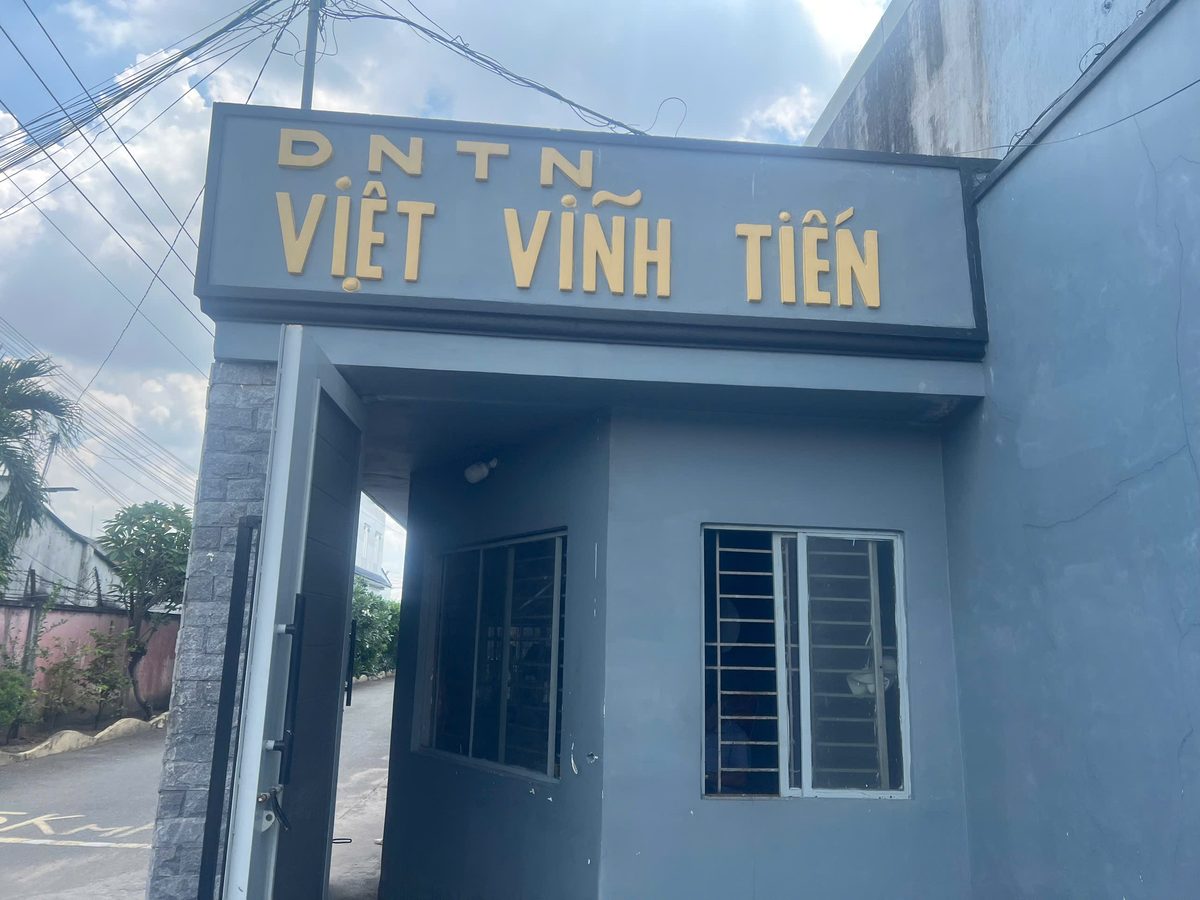
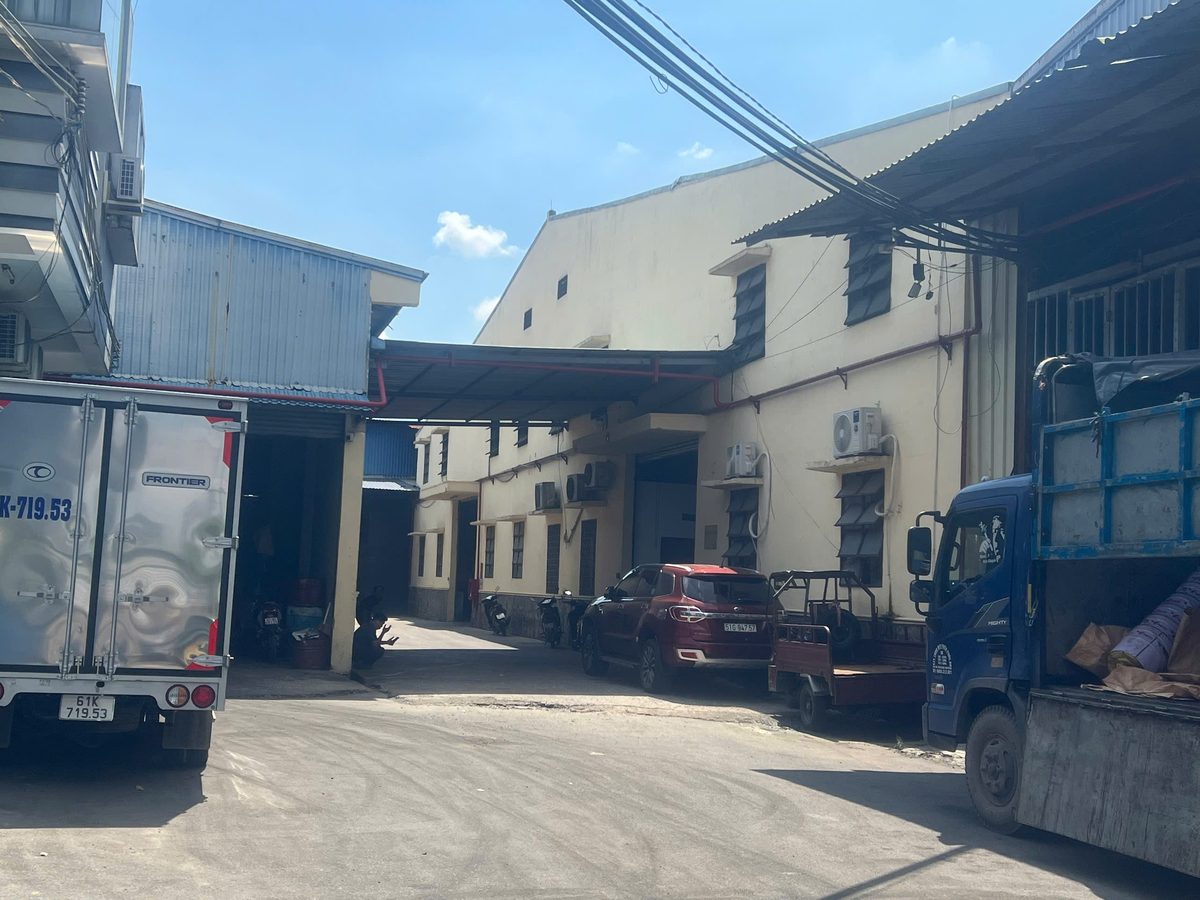
The Kinzoku Vietnam facility occupies a structured industrial compound with clearly defined workshop areas. The two exterior views show a well-maintained facility perimeter — clean, organized, with distinct entry/exit zones consistent with a factory managing separation between production and logistics flows. For buyers used to seeing photos of chaotic informal foundries on Alibaba, this level of visible organization is a meaningful baseline indicator.
Zone separation matters in die casting because the production environment involves high-temperature furnaces, molten metal handling, and pressure injection systems — all of which need to be separated from finished part handling and inspection areas to prevent contamination and rework.
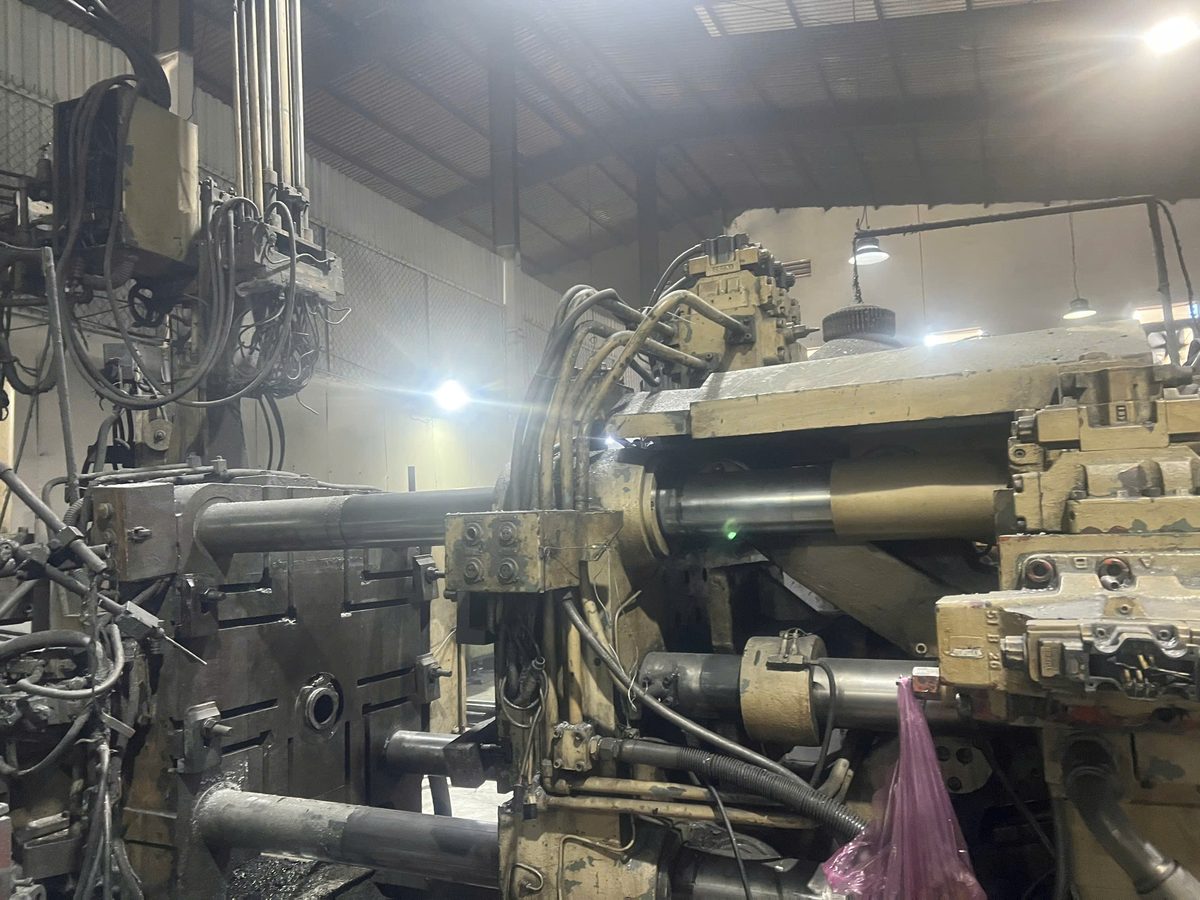
The cold chamber die casting machine is the heart of the operation. At this production scale, the machine operates dedicated tooling (die sets) that determine the finished part geometry. Cold chamber machines at this class typically handle shot weights from a few hundred grams to several kilograms, covering the vast majority of aluminum structural castings used in industrial equipment, automotive subsystems, and electronics enclosures.
The production area layout indicates dedicated press operation — not a multi-purpose floor where the die casting equipment shares space with other processes. This kind of dedicated cell configuration allows for consistent process parameters, which directly affects dimensional repeatability run-to-run.
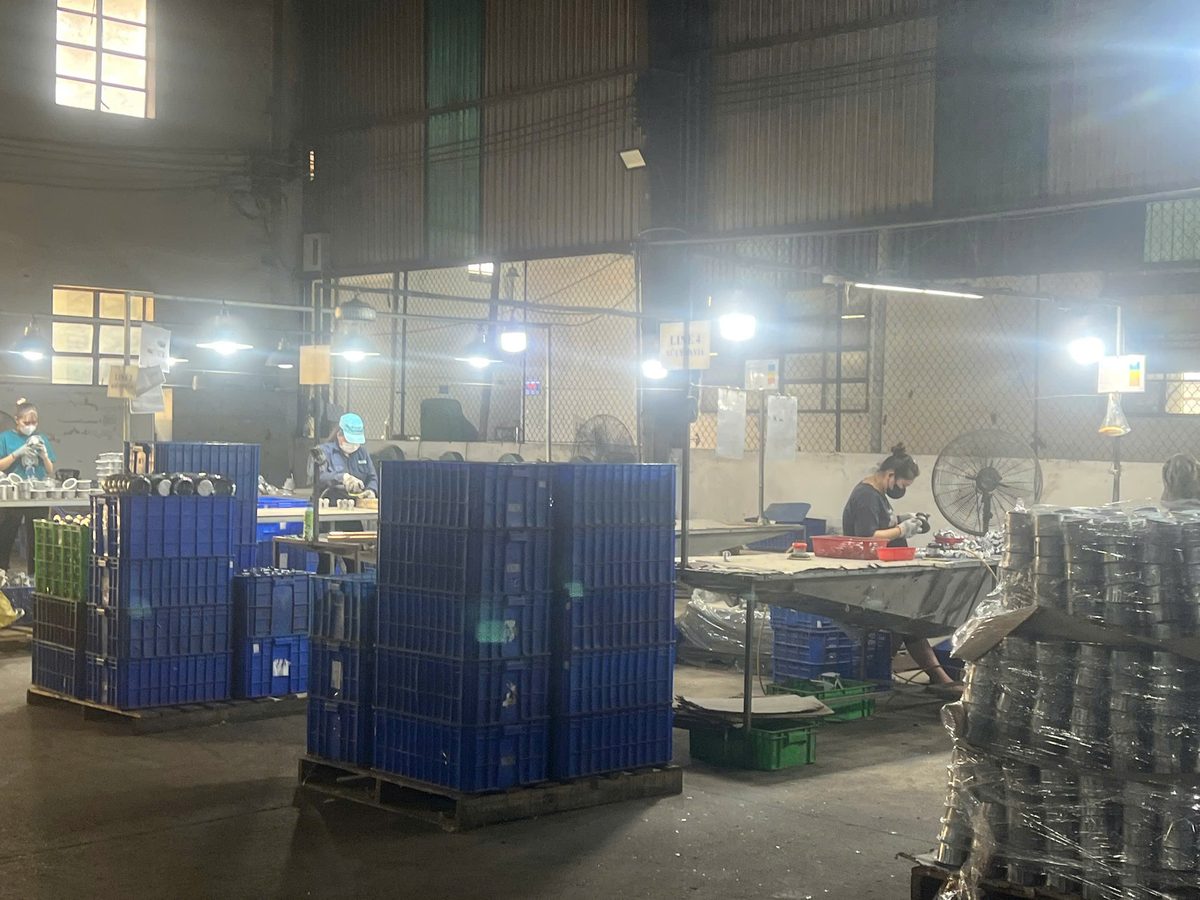
The CMM: Why This Factory Is Different From Most Vietnam Die Casters
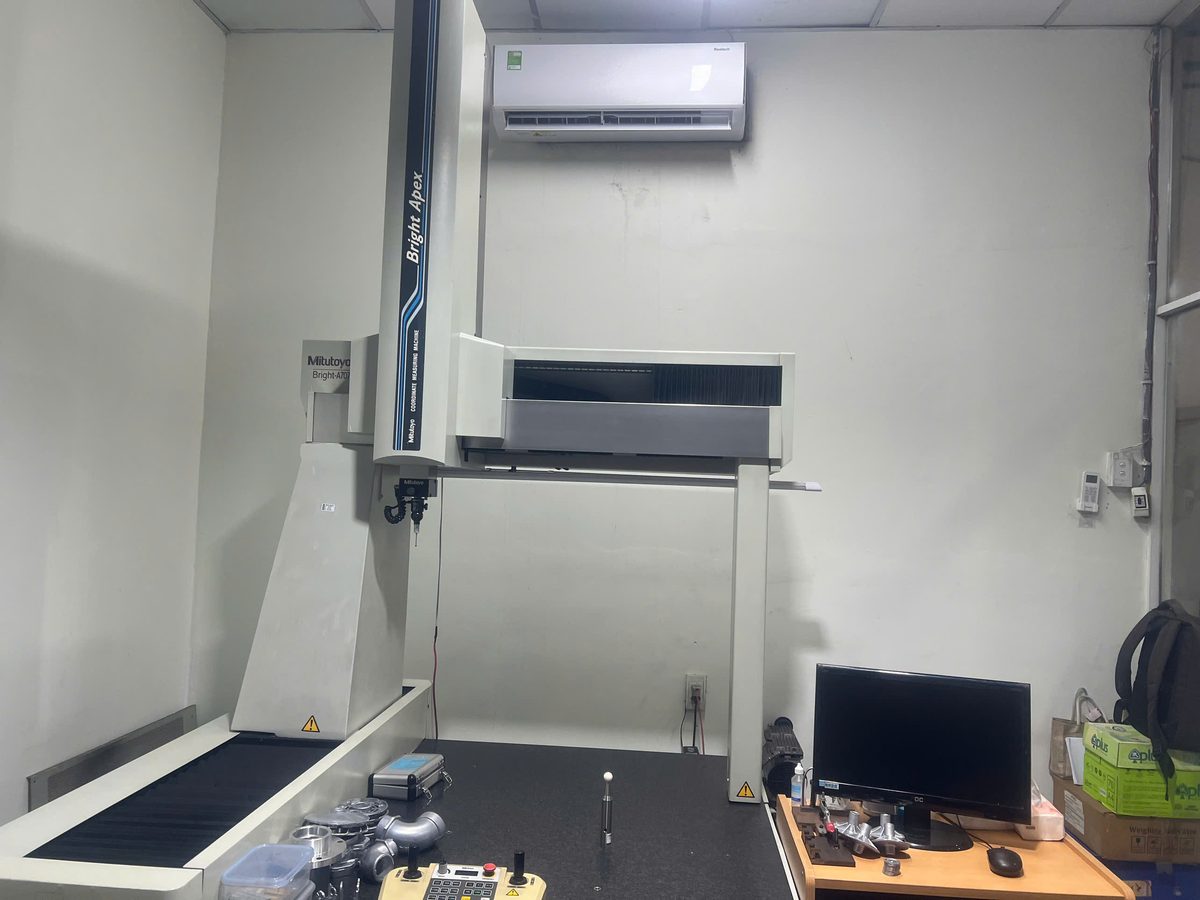
Here's the detail that separates Kinzoku Vietnam from the majority of Vietnam die casting suppliers: they have an in-house CMM (Coordinate Measuring Machine).
CMM is the gold standard for dimensional verification in precision manufacturing. A CMM uses a calibrated probe to physically touch (or scan) critical surfaces on a part and record XYZ coordinates to micron-level accuracy. The machine then compares those coordinates against your engineering drawing's GD&T callouts — flatness, perpendicularity, true position, concentricity — and generates a dimensional report that documents whether each feature is in-spec or out.
CMM vs. Conventional Inspection — What Buyers Actually Get
| Inspection Type | What It Measures | Documentation Output | FAI / PPAP Use? |
|---|---|---|---|
| Hand calipers / micrometers | Linear dimensions only (2D) | Operator handwritten log | Limited — simple parts only |
| 2D Video Measuring Machine (VMM) | Flat features, 2D profiles | Digital printout | Partial — flat geometry |
| CMM (3D Coordinate Measuring) | Full 3D GD&T: position, flatness, perpendicularity, concentricity, profile | Full dimensional report with tolerances and deviations | Yes — FAI, PPAP Level 3+ documentation |
For die casting specifically, CMM matters because die casting parts have complex 3D geometry — bosses, pockets, angled draft faces, bore IDs — that can't be fully verified with a caliper. A part may look dimensionally acceptable to a visual or caliper check but fail on true position of a bolt hole pattern, bore concentricity, or flatness of a sealing surface. CMM catches these.
For US buyers who require First Article Inspection (FAI) reports, PPAP Level 3 documentation, or dimensional inspection reports as a condition of purchase order acceptance, a CMM-equipped factory is not optional — it's mandatory. Kinzoku Vietnam's CMM capability means you can require these documents and receive them.
Section 301 Cost Comparison: China vs Vietnam for Aluminum Die Castings
| Cost Component | China Source | Vietnam — Kinzoku |
|---|---|---|
| Est. ex-factory unit cost | $14.00 (est.) | $11.00–$12.50 (est.) |
| Section 301 tariff (25%) | +$3.50 | $0.00 |
| Standard MFN duty (~3%) | ~$0.42 | ~$0.35 |
| Ocean freight (est.) | ~$0.80 | ~$0.90 |
| Est. landed cost per unit | ~$18.72 | ~$12.25–$13.75 |
| Est. savings per unit | ~$4.97–$6.47 (est. 27–35%) |
* All cost figures are estimates for illustrative purposes. Actual pricing depends on part geometry, wall thickness, alloy grade, tooling, and annual volume. "Est." denotes estimated figures per accuracy protocol.
On a mid-volume annual run of 15,000 aluminum die cast housings at those unit prices, the est. savings are in the range of $75,000–$97,000 per year — and that's before accounting for the tariff risk elimination on your balance sheet. For publicly traded companies, that tariff exposure is increasingly a line-item risk in audit discussions.
Dolphin Audit Scorecard: Kinzoku Vietnam Industrial
Dewin audits every factory in our network using the 50-point Dolphin framework — a structured on-site assessment conducted by our Vietnam-based team. For cold chamber die casting facilities, the five audit pillars assess:
1. Equipment Condition & Cold Chamber Machine Capability
✓ PassMachine tonnage, shot sleeve condition, injection pressure control, temperature management systems, die clamping integrity. Cold chamber machines must achieve consistent injection velocity and pressure to minimize porosity in structural castings.
2. Tooling & Die Management
✓ PassDie storage conditions, mold maintenance logs, shot count tracking per die, gating and runner system design, ejector pin condition. Poor die maintenance is the most common cause of dimensional drift in die castings over production runs.
3. Incoming Material & Alloy Controls
✓ PassAluminum ingot sourcing and storage, alloy certification review, melt chemistry verification procedures. Secondary aluminum without verified composition is a quality gap common in lower-tier die casters — it causes inconsistent mechanical properties across batches.
4. In-Process & Outgoing Inspection — CMM Verified
✓ Pass — CMM PresentDimensional checks per batch using CMM for GD&T verification, visual defect classification (porosity, flash, cold shut, misrun), surface condition checks, outgoing inspection record sign-off. CMM presence elevates this pillar above the standard threshold for precision parts.
5. Documentation, Traceability & COO Capability
✓ PassLot records, production batch logs, Certificate of Conformance (CoC) capability, Certificate of Origin (CO) for US customs. Vietnam-origin documentation is essential for buyers claiming $0 Section 301 at US port of entry.
Part Fit Matrix
| Part Type | Good Fit? | Notes |
|---|---|---|
| Aluminum structural housings (motor, pump, gearbox) | ✓ Yes | Core cold chamber capability, CMM-verifiable |
| Enclosures & cover plates (electronics, industrial) | ✓ Yes | Good cosmetic & dimensional control |
| Hydraulic component bodies (manifold, valve bodies) | ✓ Yes | CMM enables bore position verification |
| Automotive brackets & sub-frames (aluminum) | ✓ Yes | Verify IATF cert scope before FAI |
| Heat sinks (fin die castings) | ✓ Yes | ADC12 / A380 — standard die cast alloys |
| Zinc die castings | ~ Check | Cold chamber can handle copper alloys; confirm zinc capability separately |
| CNC machined / sheet metal parts | ✗ Not here | Use Bueno Technology, NAPEC, or HDP instead |
| Injection molded plastics | ✗ Not here | Use Lac Hao or Ming Chuan instead |
How to Source from Kinzoku Vietnam via Dewin
- Submit your RFQ — Share your 2D drawing (PDF) or 3D file (STEP/IGES), material spec (ADC12, A380, custom alloy), annual volume, and target unit cost. We handle all factory-side communication in Vietnamese.
- DFM review — Our Vietnam engineering team reviews your drawing for die casting DFM concerns (draft angles, wall thickness, parting line placement, post-casting machining requirements) and provides recommendations before tooling kicks off.
- Tooling & first article — Die tooling is produced (6–10 weeks typical for cold chamber tooling). CMM-documented First Article Inspection report generated and sent to you before production approval.
- Production run & in-process QC — Dewin Vietnam team conducts in-process inspection visits. CMM batch checks per production run. Dewin inspection report attached to every shipment.
- Pre-shipment inspection — Final dimensional and visual check by Dewin QC team. Certificate of Origin (Form B / VCCI or CPTPP CO as required) issued for US customs clearance.
- US delivery — Parts ship FOB Ho Chi Minh City or Da Nang. Typical ocean transit: 18–22 days to US West Coast, 22–28 days to US East Coast via Panama Canal.
Source Aluminum Die Castings from Vietnam — Zero Section 301
Share your drawing and we'll match you to Kinzoku Vietnam or one of 178 other verified Vietnam suppliers in the Dewin network — including factories with CMM, PPAP capability, and IATF experience.