Supplier Spotlight: Kobayashi Casting Vietnam — Lost-Wax Investment Casting with Hardness Testing
April 5, 2026 · 8 min read
Part of our Supplier Spotlight series — real factory visits, real photos, no stock images.
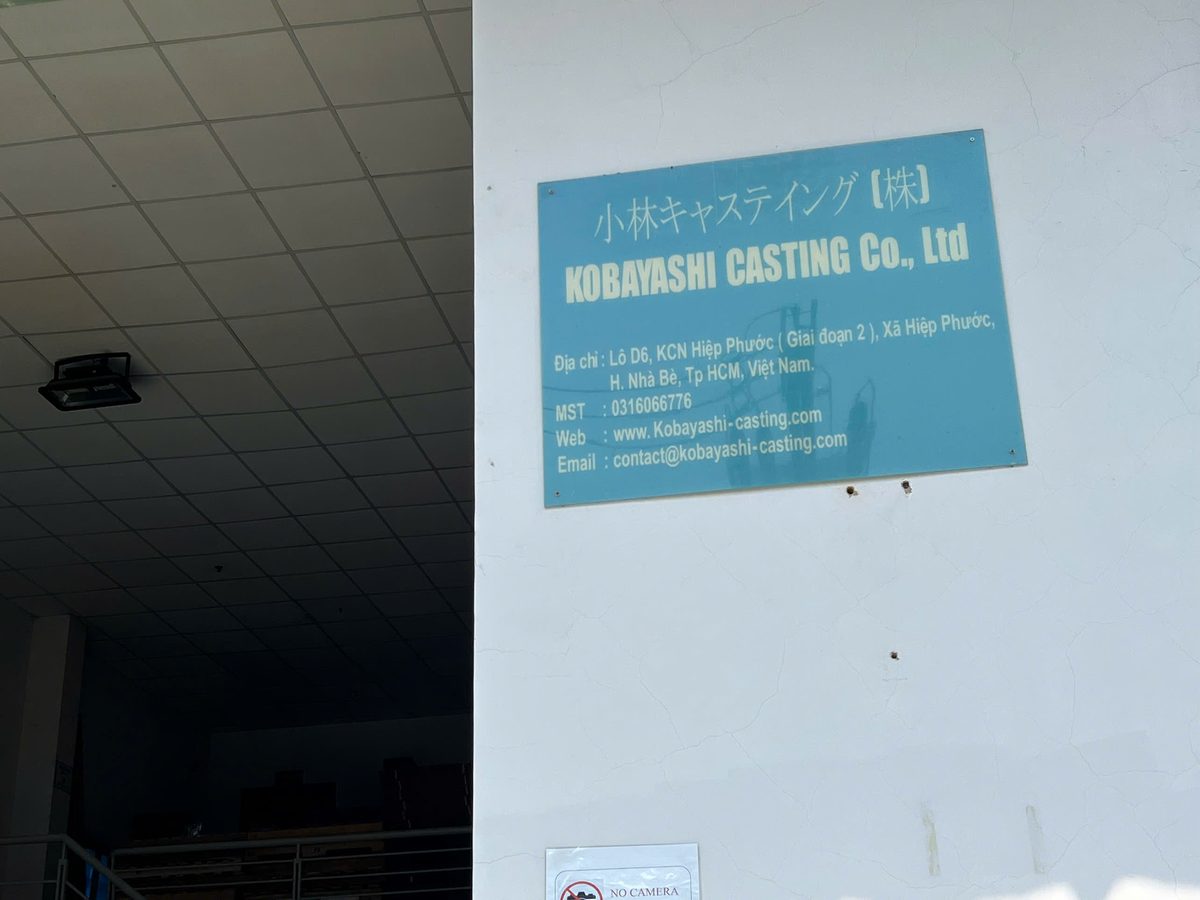
Investment casting — also called lost-wax casting — is how you make a stainless steel impeller with internal passages you can't machine, a titanium surgical instrument with complex contoured geometry, or a carbon steel valve body that requires near-net shape without extensive post-machining. When buyers move that kind of work from China to Vietnam to escape Section 301 tariffs, they need an audited investment casting supplier — not a die caster claiming they can "do castings."
This is Supplier Spotlight #13 in our ongoing series — real site visits, real photos, no stock images, no anonymous network entries. Today's factory: Kobayashi Casting Company Limited — a Vietnam-based investment casting operation with in-house wax injection capability and hardness testing inspection, audited under Dewin's 50-point Dolphin framework.
Previous spotlights: Bueno Technology (CNC), Altop (Die Casting), NAPEC (CNC + CMM), HDP (CNC + VMM), Minh Quang (Multi-Process), Eguchiseiko (Die Casting), Hirata (Japanese Machining), Huynh Duc (CNC + CMM), Lidovit (Fasteners), Ming Chuan (Injection Molding), Lac Hao (Multi-Process), Kinzoku (Cold Chamber Die Casting + CMM).
⚠️ Section 301 Tariff Alert — HTS Chapters 73 & 84
US importers pay a 25% Section 301 tariff on investment cast steel and iron components sourced from China (HTS Ch.73 — articles of iron or steel). For cast mechanical parts and fluid handling components (HTS Ch.84), an additional Section 301 layer applies. Vietnam-origin goods carry $0 Section 301 exposure. Standard MFN duty on most steel investment castings: 3–5%.
Why "Kobayashi" Is the Signal You're Looking For
Kobayashi (小林) is a Japanese surname — one of the most common family names in Japan. In Vietnamese manufacturing, Japanese naming signals something specific: a factory founded by or structured around Japanese capital, Japanese management standards, or Japanese customer supply chain requirements. It does not guarantee quality, but it is a consistent predictor of structured production discipline, documentation habits, and the willingness to invest in quality equipment that international customers can verify.
Kobayashi Casting follows this pattern. Their operation is dedicated to investment casting — not a general fabrication shop that "also does casting." The presence of in-house wax injection machinery — the first step in the lost-wax process — is an immediate differentiator from factories that claim investment casting capability but actually outsource the wax pattern production and only manage the foundry work. Control over wax patterns is control over dimensional accuracy of the final casting.
The presence of a hardness testing machine as an in-house inspection tool tells you something further: this factory serves customers who specify material hardness as a part requirement — whether for wear resistance, strength confirmation, or heat treatment verification. That means structural, load-bearing, or functional mechanical parts — not decorative castings.
Factory at a Glance
Country
Vietnam
Manufacturing Standard
Japanese-influenced — precision casting orientation
Primary Process
Investment Casting (Lost-Wax) — silica sol & water glass processes
Key Equipment
✓ In-house Wax Injection Machine + Hardness Testing Machine
Materials
Carbon steel, stainless steel (304/316/17-4PH), alloy steel, duplex steel, copper alloys
Best Fit Parts
Impellers, valve bodies, pump casings, brackets, connectors, manifolds, precision structural castings
Typical Tolerances
CT4–CT7 per ISO 8062 (tighter than sand casting, near-net shape)
Dewin Audit Status
✓ 50-Point Dolphin Audit Passed
What Is Investment Casting (Lost-Wax Casting)?
Investment casting is a precision casting process that produces near-net shape metal parts with tight tolerances and good surface finish — achievable in materials that are difficult to machine, forge, or die cast. The name "lost wax" refers to the process logic: a wax replica of the desired part is created first, then coated in ceramic slurry to build a mold, and then the wax is melted out ("lost") before molten metal is poured in.
The Investment Casting Process — Step by Step
- Wax pattern injection — Molten wax is injected into a metal die to create an exact replica of the part. Kobayashi runs this in-house.
- Pattern assembly (tree) — Multiple wax patterns are assembled onto a central wax runner system — a "tree" of parts — to allow multiple castings per pour.
- Ceramic shell building — The wax tree is repeatedly dipped in ceramic slurry and coated with refractory sand. This builds up a thick, strong ceramic shell (5–15 layers, several days).
- Dewaxing (autoclave) — The shell is heated in an autoclave or flash-fire furnace to melt and drain the wax. The ceramic mold remains.
- Casting (pouring) — Molten metal is poured into the hot ceramic mold. Metal fills the precise negative of the original wax pattern.
- Shell removal & finishing — After solidification, the ceramic shell is broken away. Parts are cut from the tree, inspected, and finished (heat treat, machining, surface treatment as required).
The critical advantage of investment casting over other casting methods is that it can produce:
- Internal passages and undercuts that can't be machined
- Very thin walls (down to ~1.5mm in stainless)
- Complex 3D geometry without a parting line visible on the part surface
- Near-net shape — minimizing post-casting machining cost
- Wide material range — carbon steel, stainless, alloy steel, duplex, copper alloys, superalloys
| Factor | Investment Casting | Die Casting | Sand Casting |
|---|---|---|---|
| Dimensional tolerance | CT4–CT7 (tight) | CT4–CT6 (tight) | CT8–CT12 (loose) |
| Suitable alloys | Steel, stainless, alloy steel, copper alloys, superalloys | Aluminum, zinc, magnesium (low-MP only) | Almost any metal — lower precision |
| Complex internal geometry | ✓ Excellent | ✗ Limited (cores difficult) | ~ Possible with sand cores |
| Surface finish (Ra µm) | 1.6–3.2 µm (good, near-net) | 0.8–1.6 µm (excellent) | 6.3–25 µm (rough) |
| Tooling cost | Medium ($1,000–$10,000+ per die) | High ($5,000–$80,000+) | Low ($200–$2,000) |
| Minimum order quantity | Low–medium (50–500 pcs typical) | High (1,000–50,000+ pcs) | Very low (1–50 pcs) |
What We Saw on the Factory Visit
The factory exterior presents a standard industrial compound perimeter with defined entry points. The gate-front presentation is clean and organized — consistent with a facility that receives customer visitors and sample review meetings. Investment casting foundries that serve international customers typically maintain more organized visitor-facing areas than those serving only domestic trade, because international customers expect visible evidence of systematic management.
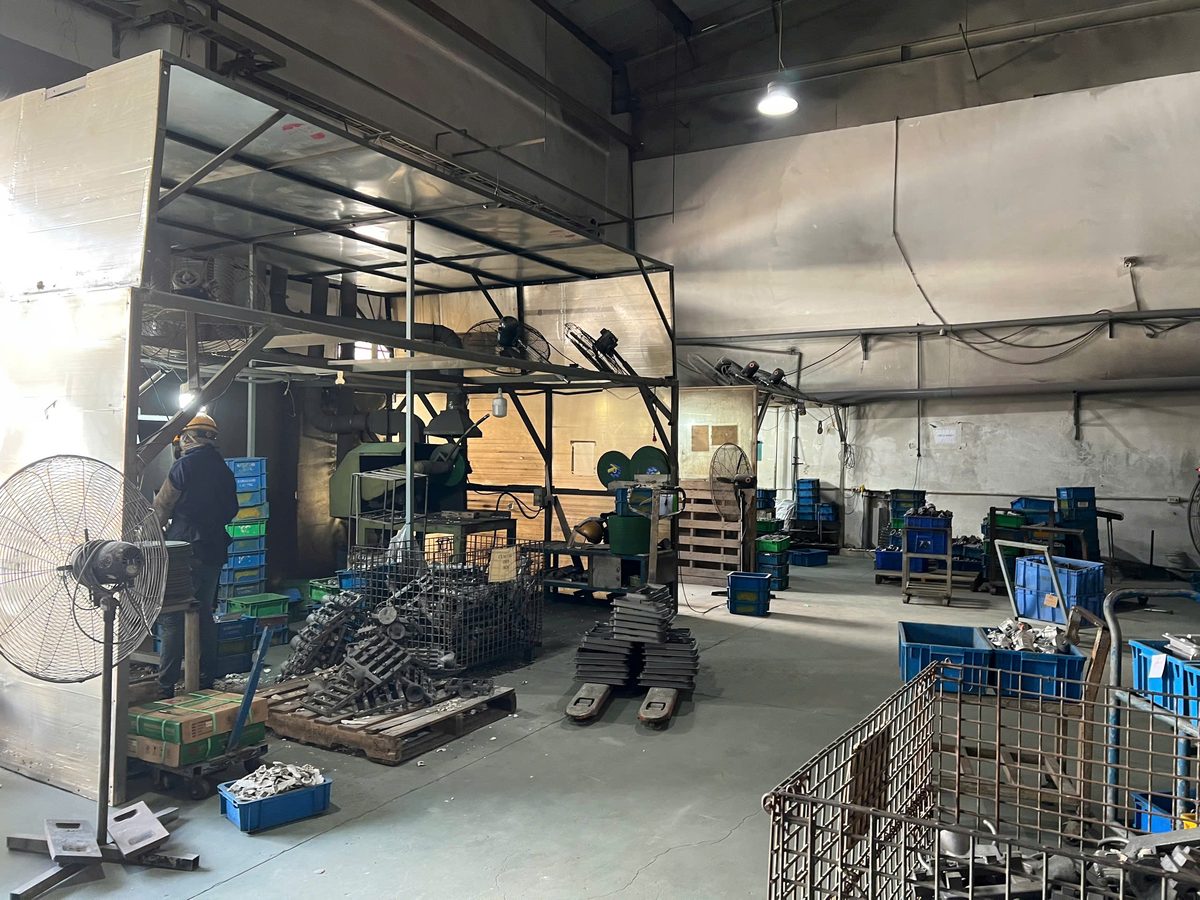
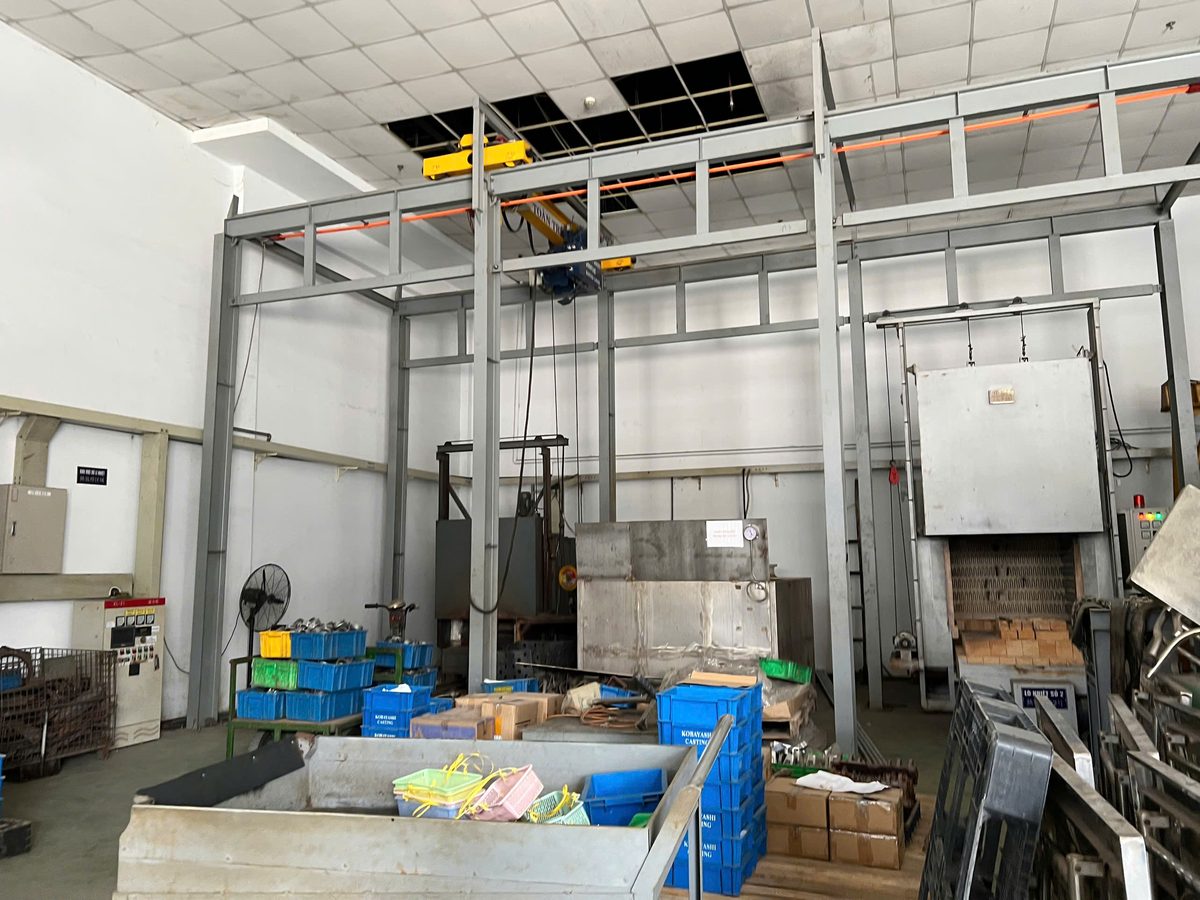
The main workshop and production area show the characteristic layout of a casting operation: distinct zones for wax work, shell-building, furnace/pouring, and finishing. The visible organization — shelving, zone demarcation, production flow — is consistent with a factory that manages multiple concurrent casting batches without mixing lot identities.
Investment casting process control depends heavily on physical zone discipline. Cross-contamination between alloy types, incorrect shell cure time, or mixed ceramic formulations can cause batch-wide failures that aren't detectable until dimensional checks after metal pouring. The zone organization visible in these photos is a meaningful indicator of management capability, not just aesthetics.
The Wax Injection Machine: Why In-House Control Matters
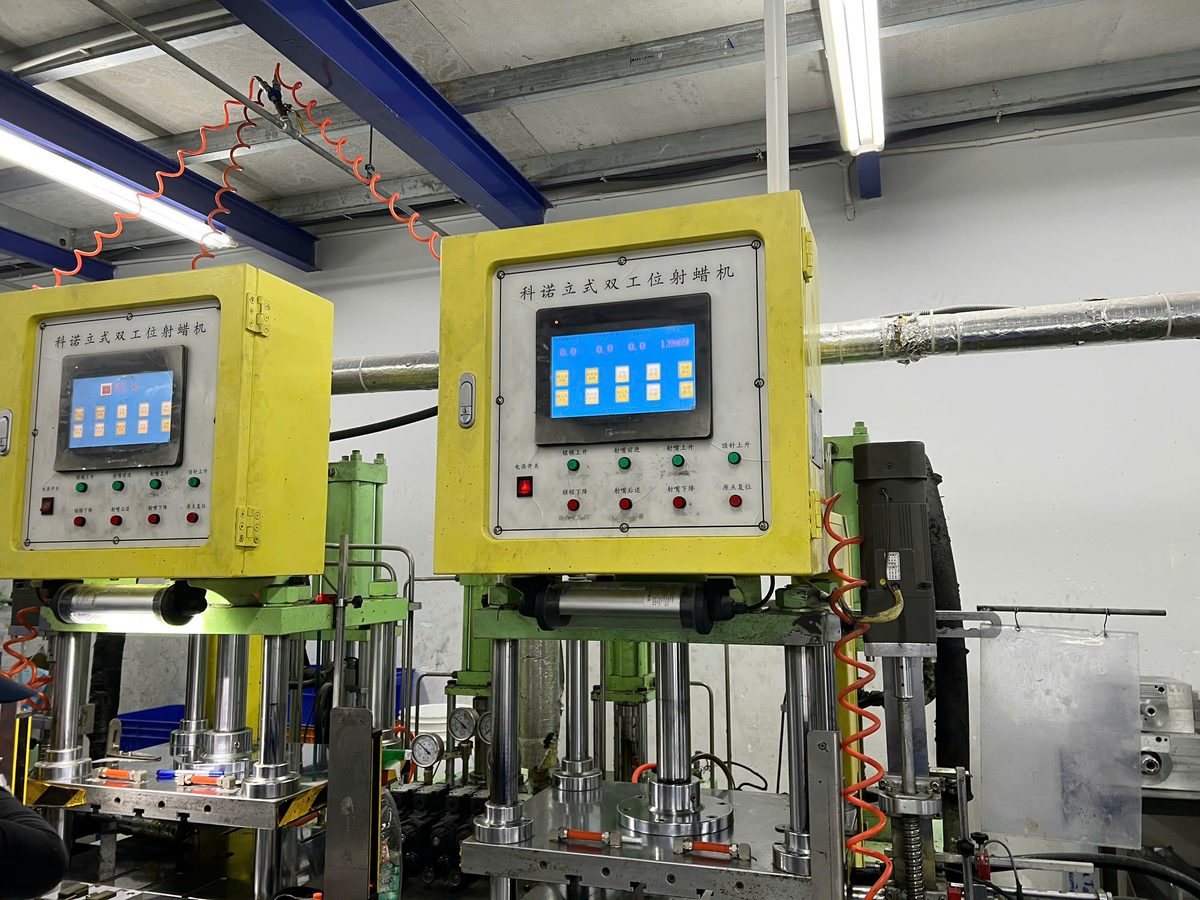
Most US buyers don't ask whether their investment casting supplier makes their own wax patterns. They should. Here's why:
Wax pattern dimensional accuracy is the foundation of final part accuracy. The wax replica is an exact positive of the finished part — every feature, every boss, every passage is defined at the wax stage. If the wax pattern is slightly undersized, oversized, warped, or dimensionally inconsistent between shots, that variation propagates into the ceramic mold and into the final casting. No amount of finishing will correct a dimensional error that was introduced at wax.
Factories that outsource wax pattern production to a sub-supplier have a hidden process step they cannot audit or control. Kobayashi Casting runs wax injection in-house — their team controls the wax material, injection parameters, die temperature, pattern removal, and cool-down fixtures. That control loop closes a gap that many investment casting buyers never think to check.
For US buyers who require First Article Inspection (FAI) documentation and consistent dimensional repeatability lot-to-lot, in-house wax control is a meaningful process advantage.
The Hardness Testing Machine: What It Tells You About the Parts
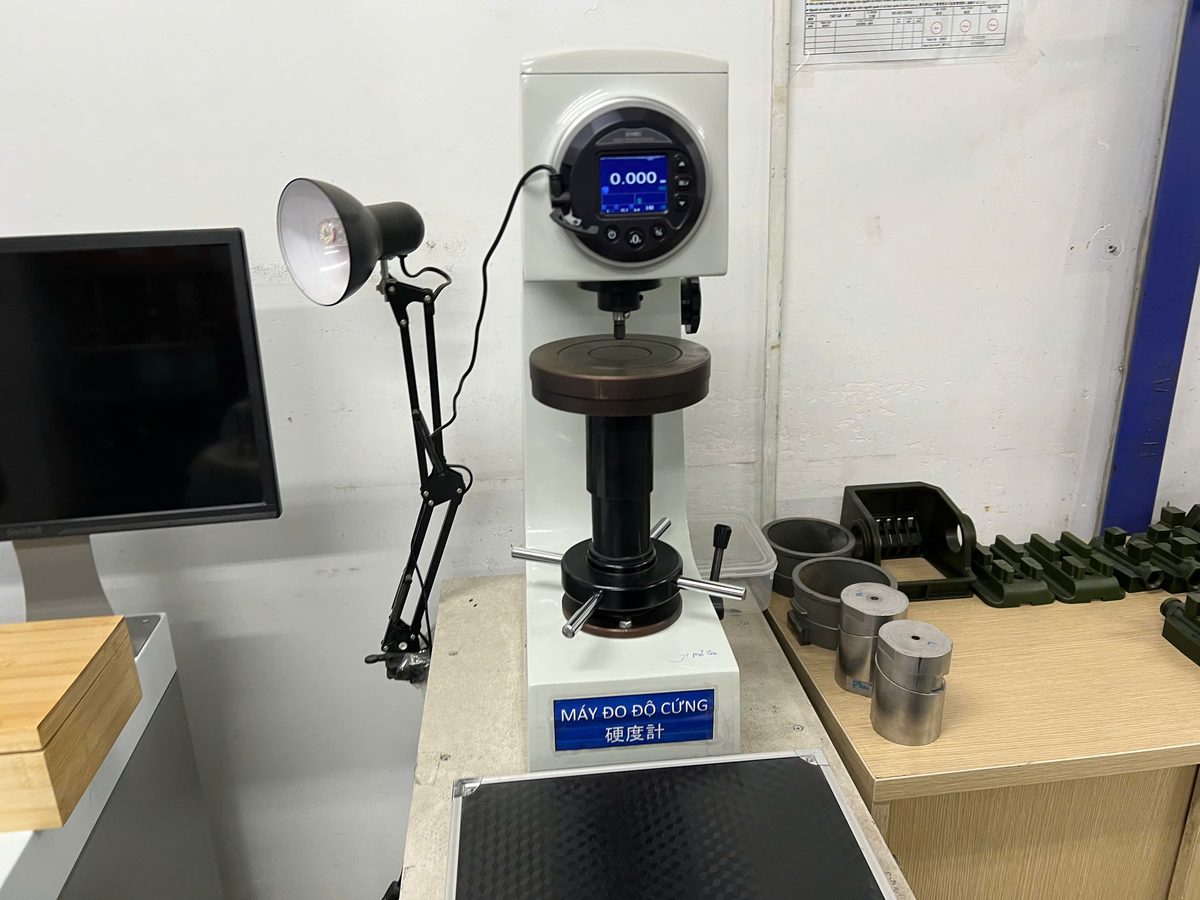
A hardness testing machine measures the resistance of a material to indentation — reported as Rockwell (HRC), Brinell (HBW), or Vickers (HV) values. For investment castings, hardness testing serves two purposes:
- Material verification — Confirming that the cast alloy delivered the specified hardness grade. A stainless steel 17-4PH casting in Condition H900 should test at 40+ HRC; a casting that tests at 28 HRC has not been properly heat treated.
- Heat treatment verification — Many investment cast parts require post-cast heat treatment (solution anneal, precipitation hardening, normalizing, quench-and-temper). Hardness is the practical verification that the correct thermal cycle was completed to spec.
Investment casting factories that do not have in-house hardness testing either skip this verification step entirely or outsource it to a third-party lab — introducing delay, cost, and a step that doesn't happen on every batch. Kobayashi's in-house capability means hardness can be checked as part of the standard outgoing inspection flow.
Hardness Ranges by Material — Investment Casting Reference
| Material | Condition | Typical Hardness | Scale |
|---|---|---|---|
| Carbon steel (WCB) | Normalized | 137–187 | HBW |
| SS 304/316 | Solution annealed | ≤192 | HBW |
| SS 17-4PH | H900 | ≥40 | HRC |
| Alloy steel (4140) | Q&T 900°F | 36–44 | HRC |
| Duplex SS (2205) | Solution annealed | ≤280 | HBW |
Section 301 Cost Comparison: China vs Vietnam for Investment Castings
| Cost Component | China Source (SS 316 valve body) | Vietnam — Kobayashi |
|---|---|---|
| Est. ex-factory unit cost | $18.00 (est.) | $14.50–$16.50 (est.) |
| Section 301 tariff (25% — HTS Ch.73) | +$4.50 | $0.00 |
| Standard MFN duty (~3%) | ~$0.54 | ~$0.45 |
| Ocean freight (est.) | ~$0.80 | ~$0.90 |
| Est. landed cost per unit | ~$23.84 | ~$15.85–$17.85 |
| Est. savings per unit | ~$5.99–$7.99 (est. 25–34%) |
* All unit cost figures are estimates for illustrative purposes only. Actual pricing depends on part geometry, alloy grade, wall thickness, heat treatment, surface finish, and annual volume. "Est." denotes estimated figures per accuracy protocol.
On an annual run of 10,000 stainless steel valve bodies, the est. savings from switching origin to Vietnam are in the range of $60,000–$80,000 per year. For companies with larger investment casting spend across multiple components, the numbers scale proportionally — each China-origin investment casting line item carries the 25% Section 301 overhead that Vietnam origin eliminates entirely.
Dolphin Audit Scorecard: Kobayashi Casting
Dewin's 50-point Dolphin Audit covers five pillars assessed on-site by our Vietnam-based team. For investment casting facilities, the assessment covers:
1. Facility & Process Zone Control
✓ PassSeparation of wax area, shell-building zone, furnace/pour area, finishing, and inspection. Lot-to-lot contamination prevention procedures. Furnace condition and temperature control equipment reviewed. Storage organization for ceramic materials, wax, and in-process patterns assessed.
2. Wax Pattern Capability — In-House Verified
✓ Pass — Wax Injection In-HouseIn-house wax injection machine confirmed operational on audit visit. Wax material specification, die condition, injection parameter controls, and wax pattern dimensional check procedures reviewed. In-house control versus outsourced pattern production represents a significant process quality advantage for dimensional repeatability.
3. Alloy & Material Traceability
✓ PassIncoming alloy (charge material) documentation reviewed. Lot-to-heat traceability system assessed — ability to link a finished casting back to its melt batch. Material Test Reports (MTRs) generation capability confirmed for alloy composition. Heat treatment batch records reviewed where applicable.
4. Inspection — Hardness Testing Verified On-Site
✓ Pass — Hardness Tester PresentIn-house hardness testing machine confirmed and calibration status reviewed. Dimensional inspection procedures (caliper, gauge) assessed for standard outputs. Hardness testing integrated into outgoing inspection routine — not only on-demand. Defect classification system (porosity, shrinkage, cold shut, misrun) documented.
5. Documentation & Certificate of Origin Capability
✓ PassLot records and heat records maintained. Material Test Report (MTR / Mill Certificate) generation procedure confirmed. Certificate of Conformance (CoC) capability verified. Certificate of Origin documentation: VCCI Form B (US MFN), CPTPP CO, RCEP CO, EVFTA Form EUR.1. Anti-circumvention documentation reviewed — castings produced from Vietnam-origin or properly documented imported billets.
Part Fit Matrix — Is Investment Casting Right for Your Part?
| Part Type | Good Fit? | Notes |
|---|---|---|
| Stainless steel valve bodies, pump casings | ✓ Yes | Core investment casting application — SS 316/304/CF8M |
| Impellers (centrifugal pump, compressor) | ✓ Yes | Complex internal geometry — investment casting advantage over machining |
| Carbon steel brackets and connectors (structural) | ✓ Yes | WCB/WCC carbon steel — hardness verifiable in-house |
| Heat-treated alloy steel components (4140, 4340) | ✓ Yes | Hardness test confirms Q&T cycle — unique in-house capability |
| Precision manifolds with internal passages | ✓ Yes | Lost wax enables internal flow channels impossible to machine |
| Large structural castings (>50kg) | ~ Verify | Investment casting typically suited to <25kg parts — confirm max pour weight |
| Aluminum die cast parts | ✗ Use Altop or Kinzoku | Investment casting is for steel/stainless — aluminum is typically die cast |
| CNC machined precision parts | ✗ Use NAPEC or HDP | CNC machining is a different process — check our CNC supplier spotlights |
How to Source Investment Castings from Kobayashi via Dewin
- Submit your RFQ — Share your 2D drawing (PDF) or 3D STEP file, alloy specification (grade, condition, heat treat if required), annual volume, target unit cost, and any inspection requirements (FAI, hardness, MTR, etc.). Dewin handles all communication with the factory in Vietnamese.
- DFM review — Our Vietnam engineering team reviews your drawing for investment casting DFM: minimum wall thickness, draft considerations, gating/runner placement, machining allowance, and surface finish achievable. Recommendations provided before tooling.
- Wax die tooling — Wax injection dies are produced (typically 4–8 weeks for standard geometry). Dewin monitors tooling progress with factory visits.
- First Article Inspection — First castings inspected dimensionally and for hardness (if specified). FAI report provided for buyer approval before production release.
- Production & in-process QC — Dewin Vietnam team conducts in-process visits. Hardness test records per heat batch, dimensional check records per lot, attached to each shipment documentation package.
- Pre-shipment inspection & COO — Final dimensional and visual inspection by Dewin QC. Material Test Reports (MTRs) and Certificate of Origin issued for US customs (VCCI Form B) or FTA markets (CPTPP/EVFTA/RCEP as required).
Source Investment Castings from Vietnam — Zero Section 301
Kobayashi Casting is one of 179+ audited factories in the Dewin network. Share your drawing — stainless, carbon steel, alloy steel — and we'll confirm fit, generate a Vietnam price comparison vs your current China supplier, and manage the full sourcing process on the ground.